


Agentic AI vs Generative AI: Key Differences in 2026
AI & Technology · 2026 Guide
Agentic AI vs. Generative AI
What’s actually different in 2026 — and which one your business, team, or project really needs.
By NuureTech Research Team·Updated July 16, 2026·12–13 min read
In this guide
- Introduction
- What Is Generative AI?
- What Is Agentic AI?
- The Core Difference (Table)
- How Agentic AI Works Under the Hood
- Benefits and Advantages
- Disadvantages and Limitations
- Real-World Applications by Audience
- Step-by-Step: How to Decide
- Future Trends 2026 and Beyond
- Expert Insight
- FAQ
- Conclusion
Quick Answer
Generative AI creates content from a single prompt — text, images, code — then stops and waits. Agentic AI pursues a goal across multiple steps: it plans, uses tools, checks its own work, and keeps going until the job is done. Most agentic systems still use a generative model as their reasoning engine; the difference is everything built around it.
Introduction
Type “AI agent” into any search bar in 2026, and you’ll find a hundred tools claiming to be one — even when they’re really just a chatbot with a new coat of paint. That mix-up isn’t harmless. Teams budget for an “agentic AI” transformation while actually buying generative AI features, and the mismatch shows up later as missed deadlines and disappointed stakeholders.
The confusion is understandable. Both agentic AI and generative AI run on similar underlying technology — large language models — and both can look impressively capable in a five-minute demo. But they solve different problems, and picking the wrong one for a project wastes time, budget, and trust.
This guide breaks down agentic AI vs. generative AI in plain terms: what each one does, how it works, where each holds up, where each falls short, and how to decide which one belongs in your workflow this year.
What Is Generative AI?
Generative AI produces new content — text, images, code, audio, or video — by learning patterns from large datasets and responding to a single prompt. Ask it a question or give it an instruction, and it returns an output based on that one request.
Picture generative AI as a well-read collaborator who answers exactly what you ask, then waits for your next instruction. It doesn’t act on its own, and it doesn’t decide what happens next.
Generative AI in everyday use
- A marketing writer asks a chatbot for five headline variations for a product launch.
- A developer asks a coding assistant to write a function that validates email addresses.
- A student asks a tool to summarize a dense research paper in plain language.
- A designer generates a batch of concept images from a text description.
In each case, the human provides the prompt, the AI produces a result, and the human decides what happens next. That single-prompt, single-response pattern is what defines generative AI.
What Is Agentic AI?

AI Invoice Factoring: How to Automate B2B Cash Flow and Get Paid Faster
Agentic AI pursues a goal across multiple steps by making decisions, calling external tools, and taking action with limited human oversight. Rather than answering one question, it plans a path toward an outcome, executes it, checks its own progress, and adjusts when something goes off track.
Think of it as a loop: perceive the current state of the task, reason about the next step, act — often by calling a tool or API — then evaluate the result before repeating. The loop continues until the goal is met or a human-set limit is hit.
Agentic AI in practice
- A support agent reads an incoming ticket, pulls order history, drafts a resolution, and logs the outcome in the CRM.
- A research agent takes a broad question, breaks it into sub-questions, checks multiple sources, and compiles a structured report.
- A finance agent monitors expense submissions, flags anomalies against policy, and routes exceptions to the right approver.
- A coding agent is assigned a bug ticket, locates the relevant files, writes a fix, runs the test suite, and opens a pull request.
The common thread: autonomy over multiple steps, not just one generated output.
Agentic AI vs. Generative AI: The Core Difference
| Aspect | Generative AI | Agentic AI |
|---|---|---|
| Primary function | Creates content from a prompt | Pursues a goal through multiple steps |
| Interaction pattern | Single prompt → single response | Continuous perceive-reason-act loop |
| Autonomy | Low — human directs each step | Higher — operates within set guardrails |
| Tool use | Limited or none | Central to how tasks get done |
| Memory across steps | Typically none by default | Often maintains task-level memory |
| Best suited for | Content creation, brainstorming, summarizing | Workflow execution, multi-step processes |
| Human role | Reviews and directs each output | Sets goals and guardrails, reviews outcomes |
| Failure mode | Produces an inaccurate one-off answer | Can compound errors across steps if unchecked |
A simple way to remember it: generative AI answers a question, while agentic AI gets a job done.
Agentic AI isn’t a replacement for generative AI — it’s usually built on top of it. Most agentic systems still use a generative model as their reasoning engine at each step. What surrounds that model — planning logic, tool access, memory, the ability to act rather than just respond — is the actual difference.
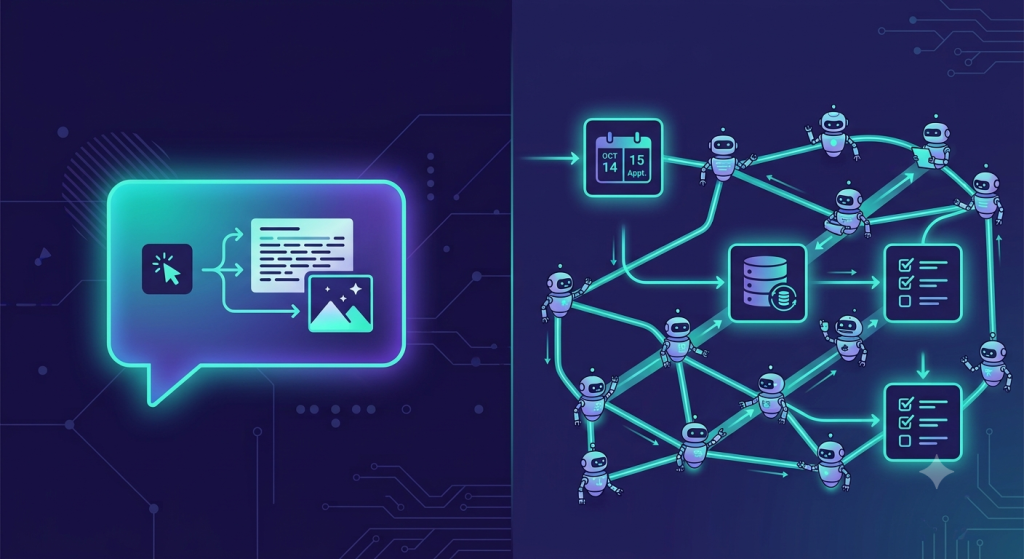
How Agentic AI Works Under the Hood
https://workos.com/blog/difference-between-causal-predictive-generative-and-agentic-ai
Understanding the mechanics clarifies why agentic systems behave so differently from a standard chatbot.
1. Goal setting
A human or another system defines an objective — “resolve this ticket,” “research this competitor,” “reconcile this month’s invoices” — rather than a single instruction.
2. Planning
The agent breaks the goal into smaller steps, deciding what information it needs and what actions it might take.
3. Tool use
This is where agentic AI diverges most from generative AI. Agents call external tools — search, databases, spreadsheets, code execution — to gather information or take action, rather than relying only on what the model already knows.
4. Execution and self-checking
The agent carries out a step, evaluates whether the result moved it closer to the goal, and decides whether to continue, retry, or escalate to a human.
5. Iteration until completion
The loop repeats — sometimes for minutes, sometimes longer — until the goal is met or a stopping condition, like a time limit or human checkpoint, is reached.
Why this changed in 2026
Clearer standards for how agents talk to tools and to each other, plus stronger evaluation and governance practices, have made this loop far more reliable than it was a couple of years ago — a major reason agentic AI has moved from lab demos into real production use.
Benefits and Advantages
Generative AI advantages
- Speed for creative and content tasks. Drafting, summarizing, and brainstorming happen in seconds.
- Low setup cost. Most tools work out of the box with a simple prompt.
- Accessibility. Non-technical users get useful output without designing a workflow.
- Consistency at scale. Small teams can produce a high volume of content or code drafts.
Agentic AI advantages
- End-to-end task completion. Multi-step processes finish without constant human handoffs.
- Reduced coordination overhead. Agents hand off between systems — CRM, email, databases — automatically.
- Continuous operation. Agents can work outside business hours on bounded tasks.
- Measurable outcomes. Hours saved and error rates are easier to track than “content generated.”
Disadvantages and Limitations
Neither technology is without real trade-offs.
Generative AI limitations
- Produces one output at a time; it doesn’t independently continue a task.
- Can generate confident-sounding but incorrect information (a known limitation called hallucination).
- Relies on training data with a cutoff date, so it can miss recent developments unless connected to live information.
Agentic AI limitations
- Higher complexity to build, deploy, and monitor safely.
- Errors can compound — a wrong decision at step two can affect steps three through ten before a human notices.
- Requires stronger governance: permissions, guardrails, and audit trails, since the system is taking action.
- Greater computational cost, since multi-step reasoning and tool calls add up compared to a single response.
Common mistake
Treating a current agentic tool as fully “set and forget.” Full autonomy without human checkpoints is still a research goal, not a 2026 production reality for most teams.
Real-World Applications by Audience
For businesses
A mid-size e-commerce company might use generative AI to write product descriptions at scale, while an agentic system handles return requests end-to-end — reading the request, checking policy, issuing a refund, and updating inventory.
For developers
Generative AI helps developers autocomplete functions and explain unfamiliar code. Agentic coding tools go further: given a bug report, they locate the issue, write a fix, run tests, and prepare a pull request for review.
For students
A student might use generative AI to brainstorm an outline, then an agentic research tool to gather sources and compare arguments — while still doing the critical thinking and final writing themselves.
For content creators
A creator might draft a video script with generative AI, then use an agentic workflow to schedule the video across platforms, generate captions in multiple languages, and monitor early engagement.
For entrepreneurs
A solo founder might use generative AI for pitch deck copy, while an agentic assistant monitors incoming leads, qualifies them against set criteria, and schedules calls — freeing time for higher-value decisions.
Step-by-Step: How to Decide Which One You Need
- Define the outcome, not the output. Need a single piece of content? That’s generative AI. Need a process completed — resolved, reconciled, published, scheduled? That points to agentic AI.
- Map the steps involved. One step usually means generative AI is enough; three or more interdependent steps often justify an agentic approach.
- Assess the risk of autonomous action. Tasks involving money, customer communication, or irreversible actions need stronger guardrails and human checkpoints.
- Start with a bounded pilot. Test on a narrow, well-defined task before expanding scope.
- Build in review points. Even agentic systems benefit from scheduled human review, especially early on.
Future Trends: Where This Is Heading in 2026 and Beyond
- Layered AI strategies. Organizations increasingly combine traditional AI for analytics, generative AI for content and code, and agentic AI for autonomous execution.
- Standardized tool protocols. Common standards for how agents connect to tools and each other are reducing the custom engineering that used to make agentic systems fragile.
- Formal ROI measurement. Businesses are moving from “this feels useful” toward tracking hours saved and error reduction.
- Stronger governance and evaluation. Structured evaluation pipelines and audit trails are becoming standard rather than an afterthought.
- Multi-agent collaboration. Specialized agents increasingly coordinate on different parts of a larger task rather than one agent doing everything.
The gap between “AI as an assistant” and “AI as an operational participant” keeps narrowing — but human oversight for high-stakes decisions remains a consistent theme across credible guidance on the topic.
Expert Insight
Analyst perspective
A useful mental model in 2026: generative AI changed what a single person could produce; agentic AI is changing what a single person can oversee. The value isn’t that agents replace judgment — it’s that they absorb the repetitive coordination work between decisions, freeing people for strategy, exceptions, and quality control.
That said, credible voices across the industry agree on one point: full autonomy without human checkpoints remains a long-term research goal, not a 2026 reality for most production systems.
Frequently Asked Questions
Is agentic AI just a more advanced version of generative AI?
Not exactly. Agentic AI typically uses a generative model as its underlying reasoning engine, but adds planning, tool use, and multi-step execution on top. Think of it as generative AI plus a framework for autonomous action, rather than a simple upgrade. Can generative AI and agentic AI be used together?
Yes, and in practice they usually are. A common setup uses generative AI for drafting and ideation, while an agentic layer handles execution — scheduling, data lookups, and multi-step workflows — around that generated content. Which is more expensive to run, generative AI or agentic AI?
Agentic AI generally costs more per task because it involves multiple reasoning steps and tool calls rather than a single response. The added cost is often justified by the labor hours saved on tasks that would otherwise need manual coordination. Is agentic AI safe for handling sensitive tasks like payments or customer data?
It can be, but only with proper guardrails — permission limits, audit logging, and human review checkpoints for high-risk actions. Deploying agentic AI on sensitive tasks without these safeguards is a common and preventable mistake. Do I need coding skills to use agentic AI tools?
Many modern agentic AI platforms offer no-code or low-code interfaces for building workflows, so coding isn’t always required. Complex or custom integrations often still benefit from developer involvement. What industries are adopting agentic AI fastest in 2026?
Customer service, software development, finance operations, and marketing automation are seeing the fastest adoption, largely because these fields involve repeatable, multi-step processes well-suited to autonomous execution. Will agentic AI replace generative AI tools?
No. Agentic AI depends on generative AI models to function, and many tasks — like drafting a single piece of content — don’t need multi-step autonomy at all. The two are complementary rather than competing categories. How do I measure ROI from an agentic AI deployment?
Common metrics include hours of manual work eliminated, error rates before and after deployment, task completion time, and outcomes directly attributable to agent-assisted processes. Defining these metrics before deployment makes results easier to evaluate. What’s the biggest risk of adopting agentic AI too quickly?
Compounding errors — a wrong decision early in a multi-step process can affect everything downstream before a human notices. Starting with bounded, low-risk pilots helps manage this risk. How is agentic AI different from traditional automation, like RPA?
Traditional automation follows fixed, pre-programmed rules and breaks when conditions change. Agentic AI reasons about the current situation and adapts its approach, making it more flexible for tasks that don’t follow a rigid script.
Conclusion
Generative AI and agentic AI aren’t rivals — they’re different tools solving different problems. Generative AI excels at producing content quickly from a single prompt: drafts, summaries, code snippets, creative variations. Agentic AI excels at completing multi-step processes with minimal hand-holding: resolving tickets, running research, executing workflows, coordinating across tools.
The smartest approach for most businesses and professionals in 2026 isn’t choosing one over the other — it’s a layered strategy that uses generative AI for creation and agentic AI for execution, with clear human checkpoints wherever the stakes are high.
If you’re evaluating AI tools for your own work, start small: pick one well-defined task, decide whether it needs a single output or a completed process, and test accordingly before scaling up.
NT
NuureTech Research Team
Expertise: Artificial Intelligence, SEO, Digital Transformation. This article was reviewed and updated on July 16, 2026 to reflect current agentic AI adoption trends.
Related Reading
- How large language models actually workA beginner’s guide to how LLMs are trained and generate responses.
- Best AI tools for content creators in 2026A roundup of leading generative AI content tools.
- AI governance and safety guardrails explainedA deeper look at responsible AI deployment and compliance.
- How to build your first AI agent workflowA step-by-step tutorial for setting up a simple agentic workflow.
- Generative AI vs traditional automationDistinguishing generative AI from RPA and rule-based automation.
NuureTech — AI, Technology & Digital Transformation Insights
https://shorturl.fm/5GE3O
https://shorturl.fm/aX692
https://shorturl.fm/hLFEh
https://shorturl.fm/ANl83