
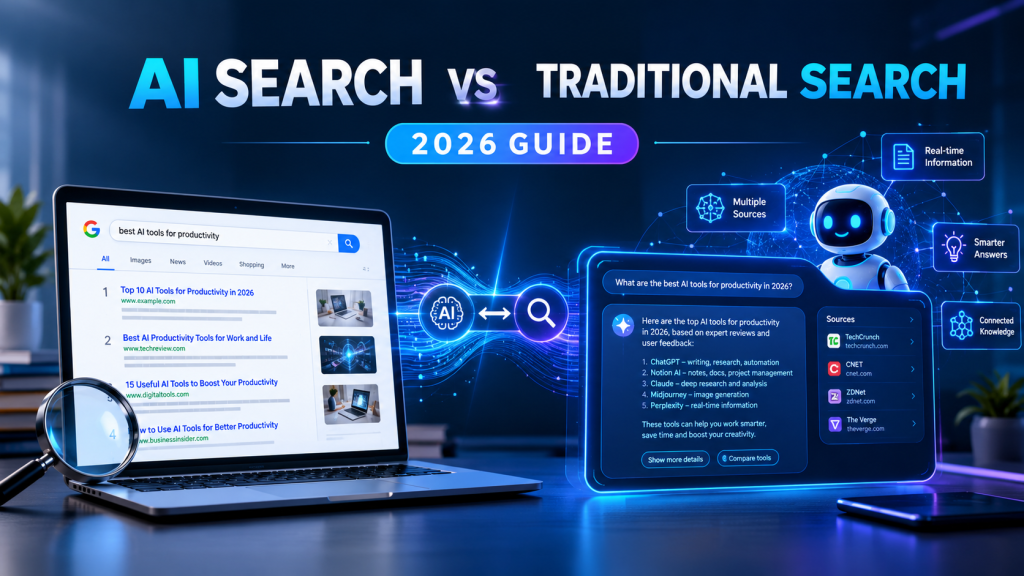
Discover how AI Overviews, AI Mode, generative search, conversational queries, and multimodal discovery are changing the way people find information online.
⚡ Quick Answer
AI Search uses artificial intelligence to understand questions, retrieve relevant information, organize sources, and in some experiences generate a synthesized response.
Traditional Search primarily helps users discover information through ranked webpages, images, videos, products, news, maps, and other search results.
In 2026, the two approaches increasingly overlap. Modern Search can combine conventional results with AI-powered answers, conversational interactions, multimodal discovery, and links to supporting sources.
The future of Search is not simply “Traditional Search vs. AI Search.” It is increasingly a combination of ranked results, AI answers, conversation, and multimodal discovery.
What Is Traditional Search?
Traditional search refers to the familiar search-engine experience where a user enters a query and receives results organized according to relevance and other ranking systems.
For example, someone might search:
best password manager for families
The search engine may return:
- Product pages
- Comparison articles
- Reviews
- Official documentation
- Videos
- Forums
- News
- Shopping results
The user then decides which sources to open, compare, and evaluate.
Query → Search results → User investigates
How Traditional Search Works
- Crawling: Search systems discover webpages.
- Indexing: Eligible content is processed and stored.
- Query understanding: The system interprets the request.
- Ranking: Relevant results are selected and ordered.
- Presentation: Results are displayed through the Search interface.
What Is AI Search?
AI Search is a broad term for search experiences that use artificial intelligence to interpret queries, retrieve information, organize results, generate summaries, support conversation, or help users explore a topic.
AI-powered search can allow users to:
- Ask questions in natural language
- Provide additional context
- Ask follow-up questions
- Compare multiple concepts
- Explore related topics
- Summarize information
- Retrieve information from multiple sources
- Search using images
- Interact with different types of media
- Discover supporting webpages
Question → Intent understanding → Information retrieval → AI synthesis → Answer + sources
AI Search vs. Traditional Search
| Feature | Traditional Search | AI Search |
|---|---|---|
| Main interaction | Search query | Natural-language question or prompt |
| Primary output | Ranked results | Synthesized or organized response plus sources |
| User role | Finds and compares sources | May begin with an AI-generated explanation |
| Follow-up questions | Often require another search | Can be conversational |
| Complex research | May require multiple searches | Can combine multiple information needs |
| Context | Primarily query-based | Can incorporate conversational context |
| Source discovery | Directly through results | Through responses and cited sources |
| Multimodal interaction | Available through specialized features | Can be integrated into AI-assisted experiences |
| SEO foundation | Relevance, accessibility, quality, usability | Same fundamentals plus useful, distinctive content |
| Main risk | Information overload | Errors, omissions, or inaccurate synthesis |
This table describes general tendencies rather than a strict division. Modern Search increasingly combines conventional results with AI-powered experiences.
How AI Search Understands Complex Queries
Compare these two searches:
Simple Query
AI search SEO
Conversational Query
How should a small technology website change its SEO strategy now that AI-generated search results can summarize information?
The second query contains several information needs:
- AI-generated search
- SEO
- Organic visibility
- Content quality
- Citations
- Website discoverability
- Publisher traffic
- User intent
AI-powered systems can potentially break complex questions into related information needs and retrieve information that helps construct a response.
Google describes query fan-out as a technique that can involve generating related searches to explore a complex question.
Modern SEO is increasingly about keywords + intent + context + topical relevance + usefulness.
Google AI Overviews vs. AI Mode
AI Overviews
AI-generated summaries can provide users with a starting point for understanding a topic while also offering links to supporting webpages.
AI Mode
A more conversational Search experience designed for questions that can benefit from deeper exploration and follow-up questions.
Why This Matters for Publishers
A webpage does not necessarily need to be the first thing a user sees to contribute to a research journey.
This makes useful source material, clear structure, topical relevance, and trustworthy information increasingly important.
What Is Changing for Search Users?
1. Searches Are Becoming More Conversational
Users can increasingly ask complete questions rather than constructing short keyword combinations.
2. One Search Can Become a Research Session
AI-assisted: Ask → Read → Follow up → Compare → Refine
3. Comparison Searches Can Become More Detailed
Instead of searching only for “ChatGPT vs Claude,” a user can describe the exact requirements they want compared.
4. Multimodal Search Is Expanding
Search is no longer limited to typed text. Users can increasingly search using visual inputs and other forms of media.
Google announced on September 24, 2026 that Search Console reporting for web multimodal search was rolling out globally. The reporting includes searches involving Google Lens, Circle to Search on Android, image uploads to Google Search, and Chrome’s “Search this image” feature.
What Is Changing for Websites and SEO?
One of the biggest misconceptions about AI Search is:
“AI Search means SEO is dead.”
Google’s current guidance does not support that conclusion.
Important foundations still include:
- Crawlability
- Indexability
- Useful content
- Logical site structure
- Internal linking
- Mobile usability
- Page experience
- Descriptive text
- Accurate structured data where appropriate
- Clear authorship
- Trustworthy sourcing
AI Search does not replace SEO. It changes some of the environments in which SEO operates.
What AI Search Means for Small Websites
A small website does not necessarily need to compete by publishing the largest number of articles.
A more sustainable approach is to build useful, distinctive topical coverage.
Generic Content
Basic definitions and repeated information that readers can find on many other websites.
Distinctive Content
Original analysis, useful examples, current documentation, genuine testing, screenshots, and practical recommendations.
The second approach gives readers more reasons to use the page and creates a stronger editorial resource.
What Makes Content Useful for AI Search?
There is no documented technique that guarantees inclusion in Google’s AI-powered Search features.
The durable strategy is to create content that is useful to people and easy for search systems to understand.
Useful Original Value Can Include:
- Original research
- Genuine testing
- Screenshots
- Comparisons
- Documented workflows
- Original examples
- Practical implementation steps
- Clearly explained limitations
- Unique analysis
- Relevant primary sources
The goal is not to write more. The goal is to contribute more.
How Website Owners Should Adapt in 2026
1. Build Topic Authority
Instead of publishing unrelated articles, create connected topic clusters.
- AI Search vs. Traditional Search
- Google AI Mode Explained
- Google AI Overviews Explained
- SEO for AI Search
- How AI Search Affects Bloggers
- Generative Search Explained
- AI Search vs. Chatbots
- How to Measure AI Search Visibility
- AI Search for Small Businesses
2. Answer the Main Question Early
Give readers the core explanation near the beginning and provide deeper information afterward.
3. Add Genuine Original Value
Ask:
What does this article provide that a generic AI summary would not?
4. Make Authorship Clear
Tell readers who wrote the article, when it was published or updated, and what sources were consulted.
5. Use Internal Links Strategically
Connect related pages naturally using descriptive anchor text.
6. Keep Important Information in Text
Do not place essential explanations only inside images, videos, animations, or interactive widgets.
7. Use Structured Data Correctly
Use appropriate structured data such as Article, BreadcrumbList, Organization, or an appropriate author profile where applicable. Do not add misleading or unsupported markup.
8. Optimize Visual Content
- Descriptive filenames
- Accurate alt text
- Useful diagrams
- Original screenshots where appropriate
- Properly sized images
SEO for AI Search: A Six-Layer Framework
Technical SEO
HTTPS, crawlability, indexability, canonical URLs, sitemap, mobile usability and internal links.
Search Intent
Understand whether the user wants an explanation, comparison, tutorial, research or another outcome.
Topical Coverage
Answer the main question and the closely related questions readers are likely to have.
Original Value
Add genuine research, testing, examples, analysis, workflows or unique information.
Trust
Use reliable sources, transparent authorship, evidence, accurate dates and clear methodology.
Measurement
Monitor Search Console, analytics, queries, pages, clicks, impressions and available multimodal data.
What Content Creators Should Stop Doing
❌ Keyword Stuffing
Repeating the same phrase does not make content more useful.
❌ Generic Summaries
Rewriting information already available elsewhere adds little value.
❌ Fake Expertise
Never invent credentials, testing experience, quotes or case studies.
❌ Secret AI SEO Tricks
There is no documented formula that guarantees inclusion in AI-powered Search features.
❌ Mass-Producing Low-Value Pages
Large-scale production without meaningful value can create Search and publisher-policy risks.
❌ Chasing Every Trend
Focus on topics that fit your audience, expertise and site purpose.
How to Measure Search Visibility
A modern SEO strategy needs measurement.
Google Search Console
- Impressions
- Clicks
- CTR
- Queries
- Landing pages
- Countries
- Devices
- Available Search appearance data
- Available multimodal Search data
Google announced web multimodal Search reporting in Search Console in September 2026, providing additional insight into searches involving visual Search experiences.
Analytics
- Engagement
- Landing pages
- Navigation paths
- Returning users
- Traffic sources
- Conversions where applicable
10 Practical Action Steps
- Audit existing content. Find outdated, thin, repetitive or poorly sourced pages.
- Improve important pages. Strengthen valuable content before creating dozens of new pages.
- Add genuine experience. Use real screenshots, testing and documented workflows when available.
- Build topic clusters. Connect several useful pages around important subjects.
- Improve author pages. Make authorship and editorial responsibility clear.
- Cite primary sources. Prefer official documentation, research and reputable technical sources.
- Make pages easy to scan. Use headings, tables, bullets and concise explanations.
- Optimize visual content. Use useful images, diagrams, screenshots and accurate alt text.
- Monitor Search Console. Track how search performance changes over time.
- Update when necessary. Change content when facts, documentation or platform behavior meaningfully changes.
Future of Search: 2026 and Beyond
Search is increasingly moving toward a combination of:
💬 Conversational
Natural-language questions and follow-up interactions.
🤖 Generative
AI-assisted summaries and synthesized information.
🖼️ Multimodal
Search using images and other forms of media.
🔎 Traditional
Ranked webpages, products, news, videos and other results.
The exact future remains uncertain. Publishers should therefore avoid building their entire strategy around predictions.
Useful + Accessible + Technically Sound + Trustworthy + Original
Frequently Asked Questions
What is the difference between AI Search and Traditional Search?
Is Google Search becoming an AI search engine?
Will AI Search replace Traditional Search?
Does SEO still matter for AI Search?
How can I optimize my website for AI Search?
Is special schema required for Google AI Search?
Does AI-generated content hurt SEO?
How can I monitor AI Search visibility?
Key Takeaways
- AI Search uses AI to interpret questions and retrieve, organize or synthesize information.
- Traditional Search primarily helps users discover and navigate to sources.
- Modern Search increasingly combines both approaches.
- AI Overviews and AI Mode are important examples of this evolution.
- Foundational SEO remains relevant to AI-powered Search.
- No special AI-specific schema is required for generative AI Search visibility.
- Unique, useful and non-generic content is more valuable than mass-produced summaries.
- Genuine first-hand experience can strengthen content when it actually exists.
- Internal linking and technical accessibility remain important.
- Search Console reporting is evolving alongside AI and multimodal Search.
- Visual content can provide additional discovery opportunities.
- The most durable strategy is people-first content supported by strong SEO fundamentals.
This guide was prepared using current publicly available documentation from Google Search Central and Google AdSense Help, with attention to AI-powered Search, Search Console reporting, multimodal Search, SEO fundamentals and publisher policies.
Search features, interfaces, reporting systems and platform policies can change over time. Readers should verify the latest official documentation when making technical or publishing decisions.
Where AI-assisted tools are used during research or drafting, the final article should be reviewed by a human editor for factual accuracy, originality, context and usefulness.
Last updated: October 2, 2026
Sources
Conclusion
The debate over AI Search vs. Traditional Search is often presented as if one must completely replace the other.
The reality in 2026 is more nuanced.
Traditional Search remains an important way to discover webpages, products, videos, news, documentation and images.
At the same time, AI-powered Search is changing how users ask questions, explore complex topics, compare information, refine searches and discover sources.
For website owners, the practical lesson is straightforward:
Do not abandon SEO. Improve it.
Build technically accessible websites. Create useful content. Add original information. Demonstrate genuine expertise or experience where appropriate. Cite trustworthy sources. Make authorship clear. Connect related content. Use useful visual content. Monitor Search Console.
Most importantly, give readers a reason to visit your website rather than simply repeating information they can find everywhere else.
The future of Search is not simply about producing more content.
It is about producing better information that deserves to be discovered.
Is Your Website Ready for the New Era of Search?
Start by auditing your most important articles. Improve their accuracy, add original value, strengthen internal links, make authorship clear, cite authoritative sources, improve technical SEO, and optimize useful visual content.
Don’t focus only on what people search for. Focus on what they actually need to know next.
Explore More AI & Technology Guides →