
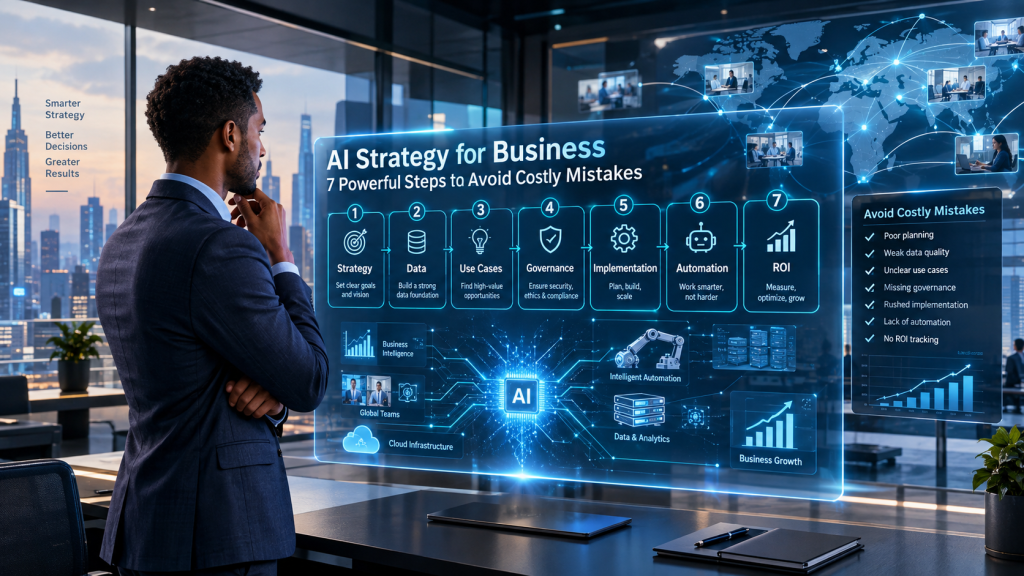

AI & Business Strategy
AI Strategy for Business: From Planning to Implementation
Learn how to build an AI strategy for business, prioritize high-value use cases, choose the right technology, manage AI risks, prepare employees, and measure business value from pilot to scale.

AI Strategy for Business: The Short Answer
An AI strategy for business is a structured plan for using artificial intelligence to solve meaningful business problems and create measurable value.
A strong AI strategy connects business objectives with AI use cases, data, technology, employees, processes, security, governance, implementation, and measurement.
The practical path is:
Business Problem → AI Opportunity → Readiness Assessment → Technology Selection → Pilot → Evaluation → Governance → Production → Measurement → Continuous Improvement
The goal is not to use as much AI as possible. The goal is to use AI where it can create meaningful value at an acceptable level of cost, risk, and complexity.
Key Takeaways
- Start with a measurable business problem rather than an AI tool.
- Prioritize AI use cases according to value, feasibility, adoption, risk, and complexity.
- Evaluate data, technology, people, processes, and security before implementation.
- Start with a controlled pilot before attempting company-wide transformation.
- Use appropriate human oversight when AI errors could have meaningful consequences.
- Measure business outcomes instead of simply counting AI users.
- Build governance, security, monitoring, ownership, and escalation procedures into the system.
- Scale successful workflows only after evidence supports further investment.
What Is an AI Strategy for Business?
An AI strategy for business is a structured plan for using artificial intelligence to achieve specific business objectives.
Rather than treating AI as a collection of software tools, a business strategy connects AI with the organization’s goals, workflows, data, employees, technology, governance, and measurable outcomes.
The Five Core Areas of an AI Strategy
- Business goals — What outcome should improve?
- AI use cases — Where can AI create useful value?
- Data and technology — What information and technical capabilities are required?
- People and processes — Who will use, manage, evaluate, and maintain the system?
- Governance and measurement — How will risk, accountability, performance, and ROI be managed?
A useful AI strategy does not begin with:
“Which AI tool should we buy?”
It begins with:
“What business outcome are we trying to improve?”
Depending on the organization, AI may support customer service, document processing, forecasting, knowledge management, software development, marketing analysis, data analysis, workflow automation, or employee productivity.
Why Businesses Need an AI Strategy
Organizations can choose from generative AI systems, AI assistants, automation platforms, predictive models, AI agents, cloud services, and specialized business applications.
The availability of technology does not automatically mean that a particular AI project is valuable. Without a strategy, an organization can accumulate tools without improving the underlying workflow.
Where Should We Use AI?
Not every process needs artificial intelligence. A simple, deterministic process may be better served by traditional software or rules-based automation.
What Type of AI Do We Need?
A chatbot, document-processing system, predictive model, recommendation system, AI assistant, and AI agent are not interchangeable. The technology should match the task.
What Risks Does AI Introduce?
- Privacy risks
- Security risks
- Incorrect or incomplete outputs
- Intellectual-property concerns
- Compliance requirements
- Bias and fairness concerns
- Unauthorized access
- Operational failures
How Will We Know Whether AI Is Working?
Every serious AI implementation should define evaluation criteria before deployment. These criteria should connect directly to the original business problem.
The AI Strategy Lifecycle
A practical business AI strategy can follow a continuous lifecycle:
Business Goal → Use Case → Feasibility → Data → Technology → Pilot → Evaluation → Deployment → Governance → Measurement → Optimization
AI implementation should not be treated as a one-time event. After deployment, organizations should continue to monitor performance, adoption, cost, security, reliability, and business outcomes.
Step 1: Start With Business Problems
One of the most common AI strategy mistakes is beginning with a technology wish list.
Instead of saying:
“We should buy an AI chatbot.”
ask:
“Our support team receives many repetitive requests. Can an AI-assisted workflow reduce response time while preserving appropriate human escalation?”
Create an AI Opportunity Map
| Business Function | Possible AI Opportunity |
|---|---|
| Customer Service | AI support assistant and response drafting |
| Marketing | Campaign analysis and content assistance |
| Sales | Lead research and qualification assistance |
| Finance | Document and invoice processing |
| HR | Employee knowledge assistance |
| Operations | Workflow automation and exception handling |
| IT | AI help desk and troubleshooting assistance |
| Software Development | Coding, testing, and documentation assistance |
| Management | Data analysis and reporting assistance |
Step 2: Identify High-Value AI Use Cases
Once business problems are identified, rank potential AI opportunities using a consistent evaluation process.
Business Value
Could the project improve revenue, reduce costs, increase productivity, improve customer experience, improve quality, or reduce operational risk?
Feasibility
Do the organization’s data, systems, skills, infrastructure, budget, and processes support the proposed solution?
Risk
What could happen if the system produces an incorrect, incomplete, biased, or inappropriate result?
Complexity
How difficult will development, integration, testing, monitoring, maintenance, and change management be?
Adoption
Will employees or customers actually use the solution? A technically capable system can still fail if it does not fit the user’s workflow.
NuureTech AI Opportunity Score
NuureTech’s practical screening model is:
Priority Score = Value + Feasibility + Adoption − Risk − Complexity
Score each factor from 1 to 5. Under this model, the theoretical score ranges from -7 to +13.
This is a NuureTech decision-support model, not an industry-standard formula. It should be used to compare candidate projects consistently rather than to replace professional risk or financial analysis.
Step 3: Evaluate AI Readiness
Data Readiness
- Where is company data stored?
- Is the data accurate and current?
- Is it structured or unstructured?
- Who owns the data?
- Who can access it?
- Can it legally and appropriately be used for the intended purpose?
Technology Readiness
- Existing software
- APIs
- Cloud infrastructure
- Databases
- Identity systems
- Security controls
- Integration capabilities
People Readiness
Determine whether the organization has people who can evaluate AI outputs, manage workflows, monitor systems, handle exceptions, manage access, and maintain integrations.
Process Readiness
AI should fit into an actual workflow. Giving employees an AI tool without changing the surrounding process does not automatically produce better results.
Readiness Questions
| Area | Key Question |
|---|---|
| Business | Is the problem important enough to justify investment? |
| Data | Do we have usable and appropriately governed data? |
| Technology | Can the solution integrate with existing systems? |
| People | Who will operate, review, and maintain it? |
| Security | Can access and sensitive information be controlled? |
| Adoption | Will users realistically change their workflow? |
Step 4: Choose the Right AI Technology
There is no universally best AI solution. The appropriate architecture depends on the problem, data, risk, budget, integration requirements, and expected outcome.
Generative AI
Generative AI can create or transform text, code, summaries, reports, images, and structured information.
AI Assistants
AI assistants can help employees search knowledge, summarize meetings, draft documents, analyze information, and prepare reports.
AI Agents
AI agents can perform multi-step tasks using tools and authorized business systems.
Greater autonomy generally requires stronger attention to permissions, testing, monitoring, logging, escalation, and failure handling.
Predictive AI
Predictive models can help organizations estimate measurable outcomes such as demand, risk, customer behavior, or equipment failures when appropriate historical data is available.
AI Automation
AI automation combines AI capabilities with traditional software workflows.
Step 5: Build an AI Implementation Roadmap
Phase 1: Discover
- Business objectives
- Existing workflows
- AI opportunities
- Data sources
- Risks
- Stakeholders
Deliverable: AI opportunity and readiness assessment.
Phase 2: Pilot
Select one high-value and manageable use case, or a small number of tightly related use cases.
- Define success criteria.
- Identify users.
- Define data requirements.
- Select technology.
- Define security requirements.
- Set a budget and timeline.
Phase 3: Production
- Integrate the workflow.
- Establish monitoring.
- Document procedures.
- Train employees.
- Assign ownership.
- Implement security controls.
- Create escalation procedures.
Phase 4: Scale
Expand successful implementations gradually. A successful pilot is evidence for further investment, not proof that every department needs the same solution.
Step 6: Prepare Data and Infrastructure
AI systems depend heavily on the quality, availability, security, and permissions associated with their inputs.
Retrieval-Augmented Generation (RAG)
Organizations that need AI systems to work with internal knowledge can use retrieval-augmented generation (RAG) to retrieve relevant authorized information before generating a response.
RAG does not automatically make an AI system accurate. Source quality, retrieval quality, permissions, evaluation, and model behavior still need to be tested.
Infrastructure Considerations
- Cloud AI services
- Databases
- APIs
- Data pipelines
- Vector databases where appropriate
- Identity management
- Logging
- Monitoring
- Secure storage
- Application integration
Step 7: Establish AI Governance and Security
AI governance should be part of system design rather than paperwork added after deployment.
Create Clear AI Policies
- Which AI tools are approved?
- What information can employees enter?
- What information must not be entered?
- When is human review required?
- How should AI-generated information be verified?
- How should incidents be reported?
Protect Sensitive Information
- Access controls
- Authentication
- Encryption
- Data retention controls
- Vendor agreements
- Audit logs
- Permission management
A useful principle is:
An AI system should not receive more access than it needs to perform its assigned task.
Human Oversight
For higher-impact workflows, AI may summarize information, identify relevant documents, or recommend an action while an appropriately qualified human remains responsible for the final decision where required.
Step 8: Prepare Employees for AI
AI transformation is both a technology project and a people-and-process project.
AI Literacy
- What AI can do
- What AI cannot reliably do
- How to give useful instructions
- How to verify outputs
- How to protect company information
Role-Specific Training
| Team | Potential AI Skills |
|---|---|
| Sales | Research and CRM workflows |
| Marketing | Campaign analysis and content workflows |
| Developers | Coding, testing, documentation, and AI APIs |
| Managers | Governance, evaluation, and decision-making |
Redesign the Workflow
Instead of asking only:
“How can employees use this AI tool?”
ask:
“How should this job be performed differently now that AI is available?”
Step 9: Build and Test AI Solutions
An AI pilot should be evaluated using a defined test set rather than subjective impressions alone.
Useful Evaluation Criteria
- Accuracy
- Relevance
- Completeness
- Response time
- Citation or source quality where applicable
- Failure rate
- Escalation behavior
- User satisfaction
Test Failure Scenarios
- Required information does not exist.
- Two sources contradict each other.
- A user requests unauthorized information.
- An instruction is ambiguous.
- An external service becomes unavailable.
- The model generates an incorrect answer.
A production AI system needs a plan for failure, not just a demonstration of successful outputs.
Step 10: Measure AI ROI
AI investment should ultimately be connected to measurable business outcomes.
A basic ROI calculation is:
AI ROI = (Financial Benefits − AI Costs) ÷ AI Costs × 100
In practice, financial benefits should be estimated carefully. Hours saved, for example, do not automatically equal cash savings unless the organization can actually convert those productivity gains into financial value.
Potential Benefits
- Reduced handling time
- More cases processed
- Lower repetitive workload
- Faster responses
- Improved employee productivity
- Improved customer experience
Potential Costs
- AI software
- API usage
- Cloud infrastructure
- Integration
- Development
- Monitoring
- Training
- Maintenance
AI KPI Dashboard
| Category | Example KPI |
|---|---|
| Productivity | Time saved per task |
| Cost | Cost per completed task |
| Quality | Error or correction rate |
| Customer | Customer satisfaction |
| Adoption | Active users and workflow adoption |
| Operations | Processing time |
| AI Quality | Evaluation score |
| Finance | Estimated business value |
AI Use-Case Prioritization Framework
Businesses do not need to automate everything at once. A prioritization matrix can help teams identify where to begin.
| Priority | Value | Complexity | Risk | Recommended Action |
|---|---|---|---|---|
| 1 | High | Low | Low | Prioritize |
| 2 | High | Medium | Manageable | Pilot carefully |
| 3 | High | High | Higher | Plan, validate, and govern |
| 4 | Low | High | High | Usually defer |
NuureTech AI Strategy Scorecard
For a more detailed screening process, score each candidate from 1 to 5.
| Factor | Score | Question |
|---|---|---|
| Business Value | 1–5 | How important is the expected outcome? |
| Feasibility | 1–5 | Can we realistically implement it? |
| Adoption | 1–5 | Will users actually adopt it? |
| Risk | 1–5 | How serious could failure be? |
| Complexity | 1–5 | How difficult is implementation and maintenance? |
| Data Readiness | 1–5 | Is the required data available and usable? |
Use the scorecard as a structured discussion tool. It should support—not replace—financial analysis, security review, legal review, or sector-specific risk assessment.
AI Strategy Maturity Model
Businesses can also think about AI adoption as a maturity journey rather than a single implementation project.
| Level | Description | Typical State |
|---|---|---|
| Level 1 — Experimenting | Employees are exploring AI independently. | Limited governance and inconsistent usage. |
| Level 2 — Controlled Adoption | Approved tools and basic policies are introduced. | More consistent and safer usage. |
| Level 3 — Workflow Integration | AI becomes part of selected business processes. | Measurable workflow improvements. |
| Level 4 — Scaled AI | Multiple departments use governed AI systems. | Enterprise-wide operating discipline. |
| Level 5 — AI-Native Operations | AI is deeply integrated into selected business processes. | Continuous optimization and strong governance. |
Not every company needs to reach Level 5. The appropriate maturity level depends on business goals, industry, resources, risk, and customer expectations.
AI Strategy Operating Model
A sustainable AI strategy needs ownership. A business should know who decides which AI projects are approved, who owns the workflow, who manages the technology, and who is responsible for monitoring outcomes.
Core Responsibilities
| Role | Primary Responsibility |
|---|---|
| Executive Sponsor | Business direction and investment decisions |
| Business Owner | Workflow objectives and business outcomes |
| AI Governance | Policies, risk, accountability, and oversight |
| Technical Team | Architecture, integration, security, and maintenance |
| Users | Operational use, feedback, and appropriate escalation |
| Monitoring Owner | Performance, quality, incidents, and ongoing evaluation |
How Much Does an AI Strategy Cost?
There is no universal price for implementing AI in a business. Costs depend on the use case, organization size, existing technology, data requirements, security needs, integration complexity, and whether the organization uses existing AI services or develops custom systems.
Common AI Cost Categories
- AI software subscriptions
- Model or API usage
- Cloud infrastructure
- Data preparation
- Software development
- System integration
- Security controls
- Employee training
- Monitoring and evaluation
- Ongoing maintenance
Why a Pilot Matters
Instead of estimating the economics of a large transformation entirely in advance, organizations can use a controlled pilot to measure actual usage, performance, operating cost, adoption, and business impact.
The objective is not to find the cheapest AI solution. It is to determine whether the expected business value justifies the total cost and risk.
Small Business vs. Enterprise AI Strategy
AI Strategy for Small Business
- Identify repetitive or expensive workflows.
- Select an appropriate AI-enabled solution.
- Automate one manageable process.
- Measure the result against a baseline.
- Train employees.
- Improve and expand gradually.
Practical opportunities can include customer-support assistance, document summarization, meeting summaries, lead research, invoice processing, knowledge management, and workflow automation.
See also: AI automation for small business .
Enterprise AI Strategy
Large organizations may require more extensive controls, including:
- Central AI governance
- Enterprise identity controls
- Data governance
- Model evaluation
- Vendor management
- Security architecture
- AI risk management
- Integration standards
- Department-level AI roadmaps
Enterprise strategy therefore needs to balance centralized governance with controlled innovation at the department level.
AI Strategy vs. AI Automation vs. AI Implementation
| Concept | Main Question | Primary Focus |
|---|---|---|
| AI Strategy | Where and why should we use AI? | Business direction and priorities |
| AI Implementation | How should we deploy the solution? | Technology, people, process, and rollout |
| AI Automation | Which workflow can AI assist or execute? | Workflow execution |
Traditional automation is often based on predefined rules. AI automation can add capabilities such as language understanding, classification, extraction, summarization, or other model-based tasks.
An AI strategy is broader. It determines where AI should be used, why it should be used, which technology is appropriate, how risk should be managed, and how business value should be measured.
For a deeper practical workflow perspective, see: AI agents for business operations .
When AI May Not Be the Right Solution
A mature AI strategy should also identify situations where AI is unnecessary or inappropriate.
- The workflow is already simple and inexpensive.
- Rules-based automation solves the problem adequately.
- Data quality is too poor for reliable results.
- The expected benefit is smaller than the implementation cost.
- The consequences of failure cannot be adequately controlled.
- Employees cannot realistically adopt the new workflow.
- The business problem has not been clearly defined.
The goal of AI strategy is not maximum AI adoption. The goal is better business outcomes.
Example: AI Strategy for a Growing Online Business
Imagine an online business whose customer-service team receives hundreds of repetitive questions about shipping, returns, product specifications, and account management.
Instead of immediately replacing the support team, the business could introduce an AI-assisted workflow.
- Analyze the most common support questions.
- Create an approved knowledge base.
- Connect an AI assistant to authorized information.
- Allow AI to draft responses.
- Require human approval during the initial pilot.
- Measure response time and answer quality.
- Expand automation for suitable low-risk requests.
- Escalate uncertain or sensitive cases.
This creates a controlled path from experimentation to production automation.
Related guide: AI in customer service .
AI Strategy Template for Businesses
Use this template to evaluate a potential AI project before investing heavily in implementation.
| Business problem | What problem are we solving? |
|---|---|
| Current process | How is the task performed today? |
| Baseline | What is the current performance before AI? |
| AI opportunity | Where can AI improve the workflow? |
| Expected benefit | What measurable outcome should improve? |
| Required data | What information is needed? |
| Technology | What AI and software components are required? |
| Risk level | What could go wrong? |
| Human oversight | Where is human review required? |
| Estimated cost | What are implementation and operating costs? |
| Success KPI | How will success be measured? |
| Pilot duration | How long will the initial test run? |
| Owner | Who is responsible for the system? |
| Scale decision | What evidence is required before expansion? |
Common AI Strategy Mistakes
1. Starting With Technology
Buying AI software before defining the business problem can create unnecessary costs.
Better: Start with measurable objectives.
2. Trying to Automate Everything
Some workflows are too risky, complex, or poorly defined for immediate automation.
Better: Begin with high-value, manageable workflows.
3. Ignoring Data Quality
AI cannot automatically turn unreliable information into reliable business intelligence.
Better: Improve data quality and access controls.
4. Measuring Usage Instead of Value
The number of employees using an AI application is not the same as business ROI.
Better: Measure productivity, quality, cost, revenue, customer experience, or another meaningful outcome.
5. Ignoring Security
Employees may unintentionally expose sensitive information through unapproved AI services.
Better: Establish clear AI usage and information-security policies.
6. Treating AI Outputs as Automatically Correct
Generative AI can produce plausible but incorrect information.
Better: Define verification requirements according to task risk.
7. Launching Without Ownership
Every production AI workflow should have a responsible owner.
8. Failing to Plan for Maintenance
Models, APIs, data sources, business processes, and vendor capabilities can change.
Better: Treat AI systems as living products that require monitoring and maintenance.
AI Governance Framework for Businesses
Businesses can use established frameworks as references when developing their own AI risk-management processes.
The NIST AI Risk Management Framework organizes AI risk management around four core functions:
- Govern — establish policies, roles, responsibilities, and accountability.
- Map — understand context and identify relevant risks.
- Measure — assess, analyze, and track identified risks.
- Manage — prioritize and act on risks.
The framework is voluntary and can be adapted to organizations of different sizes and sectors.
Businesses should adapt governance requirements to the actual risks of each use case rather than treating one checklist as appropriate for every AI application.
Official reference: NIST Artificial Intelligence Risk Management Framework .
Future of Business AI: Trends to Watch
AI Agents and Multi-Step Workflows
Organizations are exploring systems that can perform sequences of tasks rather than only answer questions.
Greater autonomy increases the importance of permissions, monitoring, testing, and failure handling.
AI-Native Business Processes
Instead of simply adding AI to an existing workflow, organizations may redesign selected processes around AI-assisted operations.
Smaller and Specialized Models
Organizations may use different models for different tasks. A simpler model may be sufficient for classification or extraction, while a more capable model may be reserved for more complex tasks.
Operational AI Governance
Governance can become an operational discipline involving monitoring, evaluation, access control, documentation, incident handling, and accountability.
Human-AI Collaboration
Many business workflows can combine AI capabilities with human judgment, relationships, strategy, creativity, exception handling, and accountability.
Limitations and Important Considerations
An AI strategy does not guarantee financial results. Outcomes depend on the quality of the business process, data, technology, implementation, employee adoption, security controls, and ongoing management.
AI systems can produce incorrect outputs, fail on unusual cases, or introduce operational risks. Higher-impact workflows therefore require stronger evaluation, controls, and appropriate human oversight.
Cost and ROI also vary significantly by organization. A solution that is economical for one company may not make financial sense for another.
This article provides a strategic framework rather than organization-specific legal, financial, cybersecurity, or compliance advice.
Expert Recommendations for Building an AI Strategy
- Choose one important problem. Start with a problem valuable enough to matter but manageable enough to solve.
- Establish a baseline. Measure the existing workflow before introducing AI.
- Prioritize objectively. Compare value, feasibility, adoption, risk, complexity, and data readiness.
- Run a controlled pilot. Test the technology with defined success criteria.
- Keep humans involved where risk requires it. Oversight should reflect the consequences of failure.
- Build security into the design. Do not wait until deployment.
- Measure outcomes. Compare the AI-assisted workflow against the original baseline.
- Document what you learn. Successful pilots should create reusable organizational knowledge.
- Assign ownership. Every production workflow should have accountable owners.
- Scale deliberately. Expand only when evidence supports further investment.
Final Takeaway
A successful AI strategy for business is not a shopping list of AI tools. It is a structured approach to solving business problems with appropriate technology while managing data, security, people, costs, governance, and risk.
The strongest strategy usually follows this path:
Business Problem → AI Opportunity → Feasibility Assessment → Technology Selection → Pilot → Evaluation → Governance → Production → Measurement → Continuous Improvement
For a small business, this may begin with one AI-assisted workflow. For an enterprise, it may become a company-wide transformation program.
The underlying principle remains the same:
Start with the business outcome, choose AI where it creates genuine value, and scale only after the evidence supports it.
Frequently Asked Questions
What is an AI strategy for business?
An AI strategy is a structured plan for using artificial intelligence to achieve business objectives. It covers use-case selection, technology, data, employees, governance, security, implementation, and measurement.
How do I create an AI strategy for my business?
Start by identifying important business problems. Evaluate potential AI use cases based on value, feasibility, risk, complexity, adoption, and data readiness. Then select a manageable pilot, define success metrics, test it, and scale it when the results justify further investment.
What are the best AI use cases for businesses?
Common opportunities include customer-service assistance, document processing, knowledge management, software development, marketing analysis, workflow automation, data analysis, and employee productivity. The best use case depends on the organization’s specific problems, data, workflow, and risk profile.
How much does business AI implementation cost?
There is no universal cost. Expenses can range from AI software subscriptions to larger investments in custom development, data infrastructure, security, integration, training, and ongoing operations. A controlled pilot can help determine the economics before a larger commitment.
What is enterprise AI strategy?
Enterprise AI strategy is the coordinated approach a large organization uses to adopt and scale AI across departments. It can include governance, security, data management, technology architecture, employee adoption, vendor management, and performance measurement.
Should small businesses use AI?
Small businesses can benefit from AI when it solves a genuine operational or customer problem. They do not necessarily need to build custom AI models because existing AI software, cloud services, and automation tools can address many practical needs.
What is AI governance?
AI governance is the framework an organization uses to manage AI responsibly. It can include policies, access controls, security, privacy, testing, monitoring, human oversight, documentation, incident management, and accountability.
How do you measure AI ROI?
AI ROI can be evaluated by comparing measurable benefits with implementation and operating costs. Useful measures can include hours saved, reduced costs, increased revenue, improved quality, faster processing, customer satisfaction, productivity, and other business-specific outcomes.
What is the difference between AI automation and AI strategy?
AI automation focuses on using AI to execute or assist with specific workflows. AI strategy is broader and determines where AI should be used, why it should be used, which technology is appropriate, how risks should be managed, and how business value should be measured.
Should AI replace human employees?
AI adoption decisions should be based on business outcomes, workflow design, risk, employee impact, and customer needs rather than an assumption that automation should always replace human work. AI can augment employees, automate repetitive work, and help people focus on judgment, relationships, creativity, and other higher-value activities.
When should a business not use AI?
A business may not need AI when a simple rules-based system already solves the problem, the data is unsuitable, the expected benefit is too small, implementation costs are too high, or the consequences of failure cannot be adequately controlled.
What is an AI strategy maturity model?
An AI strategy maturity model describes stages of organizational AI adoption, from experimentation and controlled adoption to workflow integration, scaled AI, and more deeply integrated AI-enabled operations. Not every organization needs to reach the highest level.
Sources and Further Reading
The following official resources are useful for verifying search, structured-data, AdSense, and AI risk-management guidance discussed in this article.
- Google Search Central — Article Structured Data
- Google Search Central — Breadcrumb Structured Data
- Google Search Central — General Structured Data Guidelines
- Google AdSense — What to Do When Your Site Is Not Ready to Show Ads
- Google AdSense — Make Sure Your Site’s Pages Are Ready for AdSense
- NIST — Artificial Intelligence Risk Management Framework
Sources are provided for verification and further reading. Technology, policies, products, and AI capabilities can change. Readers should verify current official documentation before making high-impact business, technical, legal, security, privacy, or compliance decisions.
What Should You Do Next?
Choose one important business problem, establish a baseline, evaluate whether AI is actually appropriate, and design a small controlled pilot before making a larger investment.
Start with: AI automation for small business .