
AI & Technology
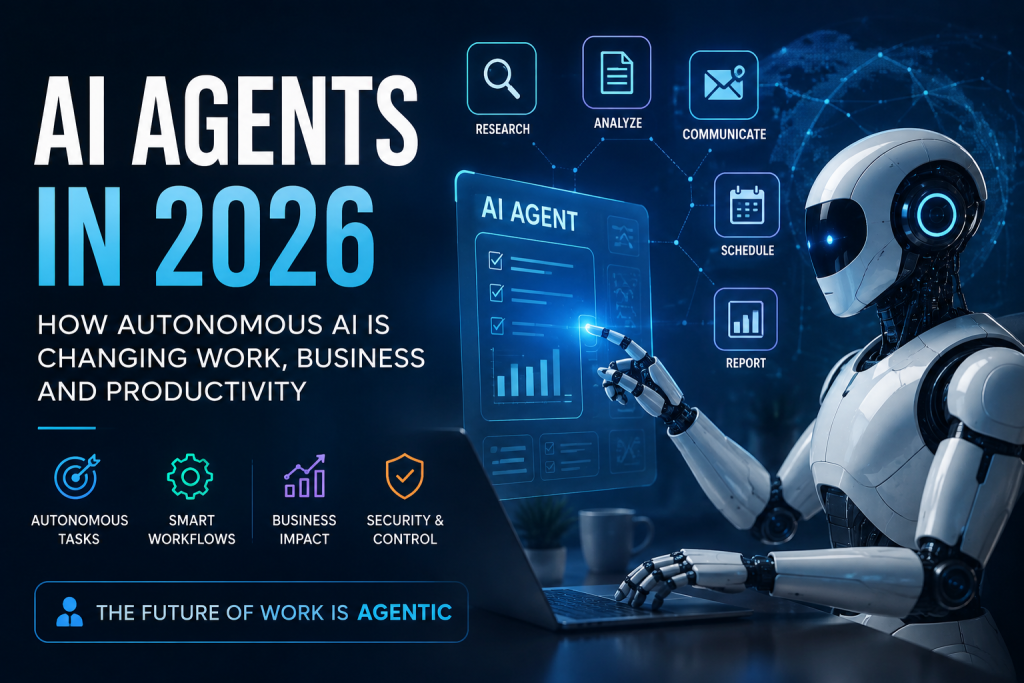
AI Agents in 2026: How Autonomous AI Is Changing Work, Business and Productivity
Published: August 13, 2026 | Updated: August 13, 2026 | Reading Time: 12–15 minutes
Primary Keyword: AI agents in 2026

Introduction
Artificial intelligence is entering a new phase. For several years, many people experienced AI mainly through chatbots. You typed a question, the AI generated an answer, and you decided what to do next.
In 2026, that model is expanding. AI agents are designed to do more than generate text. Depending on their design and permissions, they can plan tasks, use software tools, retrieve information, interact with applications, evaluate intermediate results and continue through multiple steps with less human intervention.
OpenAI, Google and Microsoft are among the major technology companies developing increasingly agentic AI systems and workflows.
The important question is therefore changing from:
“How intelligent is the AI?”
to:
“Can the AI reliably complete useful work?”
That distinction could define one of the most important developments in the AI industry in 2026.
What Is an AI Agent?
An AI agent is an AI-powered system designed to pursue a goal by performing multiple steps, using available tools and responding to the results of those actions.
A traditional chatbot often follows this pattern:
Question → AI response → Human action
An AI agent can work more like this:
Goal → Planning → Tool use → Action → Evaluation → Next action → Result
A Simple Example
Imagine asking an AI:
“Find three suitable hosting providers for my website, compare their features and prices, and prepare a recommendation.”
A more capable agent could potentially:
- Search relevant sources.
- Collect information.
- Compare features.
- Check pricing information.
- Organize the findings.
- Identify important differences.
- Prepare a recommendation.
- Ask for human approval before taking a consequential action.
The human still needs to verify important information, especially when prices, contracts, security or business decisions are involved.
AI Agents vs Traditional Chatbots
The easiest way to understand agentic AI is to compare it with traditional chatbots.
Traditional AI Chatbots
- Answer questions
- Summarize documents
- Generate text
- Brainstorm ideas
- Translate content
- Explain concepts
- Create drafts
The interaction is usually straightforward:
User asks → AI answers → User decides what happens next.
AI Agents
AI agents attempt to take a larger role in execution. Depending on the system, an agent may:
- Break a goal into smaller tasks
- Search for information
- Use APIs
- Interact with applications
- Analyze files
- Write or modify code
- Run tests
- Monitor processes
- Evaluate intermediate results
- Request human approval
However, AI agent does not automatically mean fully autonomous AI. Many real-world systems remain narrowly scoped and require human oversight.
Why Are AI Agents Trending in 2026?
1. AI Models Are Becoming More Capable
Modern AI systems can handle increasingly complex instructions, multimodal inputs and tool-based workflows.
2. AI Can Connect to More Tools
An AI model becomes more useful when it can interact with external systems such as search engines, databases, APIs, browsers, files and business applications.
3. Businesses Want Automation
Generative AI demonstrated that machines can create text, images and code. Businesses are now increasingly interested in whether AI can also execute the workflows surrounding those outputs.
4. Enterprise Interest Is Growing
Gartner’s 2026 analysis reports significant organizational interest in AI agents while also warning that many enterprise deployments remain narrowly scoped and that fully autonomous agents are not yet ready for most enterprise use cases.
This creates an important distinction:
High interest does not necessarily mean high maturity.
How AI Agents Actually Work
An AI agent normally combines several technical components.
1. AI Model
The underlying AI model provides language, reasoning and multimodal capabilities.
2. Instructions and Goals
The agent receives a goal that defines what it should accomplish.
Example:
“Analyze these customer reviews and identify the five most common complaints.”
3. Tools
Tools provide capabilities beyond text generation.
- Web search
- Databases
- APIs
- Browsers
- Code execution
- File systems
- Business software
4. Memory and Context
An agent needs relevant information about the task. This can include previous actions, documents, instructions and conversation context.
5. Planning
The system may divide a larger goal into smaller tasks and determine which tools should be used.
6. Evaluation
A capable agent should evaluate whether an action succeeded and whether another step is necessary.

Where Are AI Agents Being Used?
Software Development
Coding is one of the most visible areas for AI agents. Coding agents can help developers understand existing code, find bugs, write code, modify files, run tests and explain technical errors.
However, more automation does not automatically mean better software. Developers still need to review code, test security and evaluate whether the final result solves the intended problem.
Customer Service
A customer-service agent could potentially read a request, identify the issue, retrieve account information, search company policies, recommend a solution and escalate complicated cases to a human.
The potential benefit is not simply faster answers. The larger opportunity is reducing repetitive manual steps.
Research
AI agents can assist with research workflows by searching multiple sources, extracting information, comparing findings, organizing evidence and creating summaries.
Important claims should always be verified against authoritative or primary sources.
Marketing
Marketing teams can potentially use AI agents for keyword research, content planning, competitor analysis, social media planning, customer segmentation and performance reporting.
Human editorial judgment remains important when accuracy, reputation, privacy or compliance matters.
AI Agents for Small Businesses
Small businesses may benefit from AI agents because many business workflows contain repetitive tasks.
- Customer questions
- Email drafts
- Product descriptions
- Sales reporting
- Inventory analysis
- Appointment scheduling
- Market research
- Social media planning
Low-Risk Example
Generate a weekly sales summary.
Higher-Risk Example
Automatically refund every customer.
Higher-risk actions should normally use clear rules, strong permissions and human approval.
A practical approach is:
Start small → Measure → Add controls → Expand gradually.
The Biggest Problem: Reliability
AI agents sound impressive, but capability is not the same as reliability.
An agent that can perform a task is not necessarily an agent that can perform the task reliably.
A mistake in a business workflow could cause:
- Incorrect information
- Financial losses
- Privacy problems
- Customer complaints
- Security incidents
- Compliance problems
Organizations therefore need more than a powerful AI model. They also need permissions, monitoring, testing, logging, evaluation, security controls and human oversight.

AI Agent Security: Why Permissions Matter
The more systems an AI agent can access, the greater the potential impact of an error or security problem.
An agent that only summarizes documents has limited ability to cause external consequences. An agent that can send emails, modify databases, access customer information or execute code has much greater responsibility.
One important security principle is:
Give an AI agent only the permissions it actually needs.
AI-agent security should therefore be treated as a software-security problem, not simply as a chatbot feature.
The Human-in-the-Loop Model
One practical approach is human-in-the-loop AI. Instead of allowing an agent to perform every action automatically, the system asks a human to approve sensitive actions.
Example
AI Agent: Customer requested a $500 refund.
Agent Recommendation: Refund appears to satisfy company policy.
Human: Approve.
AI Agent: Refund processed.
This model can be particularly useful for:
- Financial decisions
- Legal documents
- Medical information
- Security operations
- Customer refunds
- Account changes
- Sensitive communications
- Public publishing
AI Agents and Jobs
The rise of AI agents naturally raises another question:
Will AI Agents Replace Human Workers?
There is no simple yes-or-no answer.
AI agents can automate some tasks, change other tasks and create new responsibilities around managing AI systems.
Workers can benefit from developing skills such as:
- Critical thinking
- Problem solving
- Communication
- Domain expertise
- Leadership
- Creativity
- AI literacy
- Verification
- Decision-making
- Workflow design
The future may therefore be less about competing directly against AI and more about learning how to work effectively with AI systems.
Open-Weight AI Models and the Future of AI Tools
Another important development in the AI market is growing interest in models whose weights can be downloaded or adapted under their respective licenses.
Open-weight models can provide organizations with different options for:
- Customization
- Deployment control
- Cost management
- Privacy-sensitive workloads
- Specialized applications
However, open-weight does not necessarily mean completely open source. Licensing terms can differ significantly between projects.
| Model Type | Potential Use |
|---|---|
| Frontier model | Complex reasoning and difficult tasks |
| Smaller model | Routine or lower-cost workflows |
| Open-weight model | Customization and deployment control |
| Specialized model | Industry-specific tasks |
What Does the Rise of AI Agents Mean for Everyday Users?
For ordinary users, one of the biggest changes may be simplicity.
Instead of manually opening multiple applications and moving information between them, users may increasingly ask an AI system to coordinate several steps.
“Research this topic, summarize reliable sources, create an outline, prepare a draft and give me five social media ideas.”
Agentic systems may increasingly coordinate several parts of such workflows.
But users should not blindly trust the result.
AI research → Source verification → Human editing → Final review → Publication
How Bloggers Can Use AI Agents Responsibly
1. Research
Use AI to discover possible topics, questions and search-intent ideas.
2. Keyword Research
Use professional SEO tools to identify search intent, keyword opportunities, competition and content gaps.
3. Outline
Ask AI to create a logical structure for the article.
4. Draft
Generate a first draft, then rewrite and improve it.
5. Fact-Check
Verify important claims against authoritative sources.
6. Editing
Improve readability, clarity, structure and remove unnecessary repetition.
7. Images
Create or source relevant visuals and use descriptive ALT text.
8. SEO
- SEO title
- Meta description
- Headings
- Internal links
- External references
- Image ALT text
- URL
- Structured data
9. Human Review
Read the complete article yourself before publication. AI should be treated as a tool, not as an automatic publishing machine.
How to Use AI Agents Safely
- Choose one repetitive task.
- Define the goal clearly.
- Limit permissions.
- Add human approval for sensitive actions.
- Test before production.
- Monitor accuracy, cost and errors.
- Expand automation gradually.
What Should You Watch Next in AI Agents?
1. More Agentic AI Tools
AI applications are likely to continue moving toward task execution.
2. Better Computer Use
Agents are increasingly focused on interacting with software environments.
3. AI Coding Agents
Software development will remain an important area for agentic AI.
4. Enterprise AI
Businesses will increasingly evaluate whether AI agents produce measurable value and return on investment.
5. AI Security
As agents gain access to more systems, permissions, identity and security will become increasingly important.
6. Smaller and More Efficient Models
Businesses may increasingly compare capability against cost, latency, privacy and deployment requirements.
7. Agent Governance
Organizations will need clear answers about which agents exist, what they can access, what actions they can perform and who is responsible for their outcomes.
AI Agents: Benefits vs Risks
| Potential Benefits | Potential Risks |
|---|---|
| Faster workflows | Incorrect actions |
| Less repetitive work | Security vulnerabilities |
| Improved productivity | Privacy concerns |
| Multi-step automation | Hallucinations |
| Tool integration | Unexpected costs |
| Faster research | Poor-quality outputs |
| Business automation | Over-automation |
| Personalized assistance | Lack of human oversight |
The right goal is not maximum automation. It is appropriate automation with appropriate controls.
Key Takeaways
- AI agents in 2026 are moving beyond simple chatbot interactions.
- Agentic AI systems can combine models, tools, context, planning and evaluation.
- OpenAI, Google and Microsoft are actively developing agentic AI technologies.
- Enterprise adoption is growing, but maturity varies significantly.
- Reliability remains one of the biggest challenges.
- Security and permissions become more important as agents gain access to systems.
- Human oversight remains important for sensitive actions.
- AI agents may transform software development, research, customer service and marketing.
- Smaller and open-weight models may increase choices around cost and customization.
- AI literacy and domain expertise can help workers adapt to changing workflows.
Frequently Asked Questions About AI Agents
What is an AI agent?
An AI agent is an AI system designed to pursue a goal by performing multiple steps, using tools and evaluating results.
Are AI agents the same as ChatGPT?
Not necessarily. A chatbot primarily responds to prompts, while an AI agent can be designed to perform multi-step tasks using external tools.
Are AI agents fully autonomous?
No. The level of autonomy varies between systems. Many real-world deployments remain narrowly scoped and use human approval and monitoring.
Can AI agents replace human workers?
AI agents can automate some tasks and change others, but the impact depends on the occupation, workflow, regulation and level of human judgment.
Are AI agents safe?
AI agents are not automatically safe. Their safety depends on their design, permissions, data access, testing, monitoring and human oversight.
What are AI agents used for?
Potential applications include software development, research, customer service, marketing, reporting, scheduling and other multi-step workflows.
What is agentic AI?
Agentic AI generally refers to AI systems designed to pursue goals and perform actions with some degree of planning, tool use and autonomy.
Should bloggers use AI agents?
Bloggers can use AI agents to assist with research, outlining, editing, SEO workflows and other repetitive tasks. Important claims should be fact-checked and final content should receive human editorial review.
Conclusion: AI Is Moving From Answers Toward Actions
The next important AI development may not simply be another chatbot. It may be the transition from AI that answers to AI that increasingly acts.
In the traditional software model, people use applications and AI helps them complete individual tasks. In an emerging agentic model, people can increasingly describe a goal while AI systems coordinate more of the execution.
But this does not make human responsibility irrelevant.
People still need to decide:
- What should the AI do?
- What information can it access?
- Which actions require approval?
- How should results be verified?
- What happens when the AI makes a mistake?
- Who is responsible for the final outcome?
For businesses, the opportunity is not simply to deploy the most autonomous AI possible. The opportunity is to build useful, measurable and controlled workflows.
For individual AI users, the practical lesson is simple:
Don’t just learn how to ask AI questions. Learn how to build useful workflows around AI.
That may be one of the most valuable AI skills to develop in 2026.
What do you think? Are AI agents the next major revolution in AI tools, or is the industry moving too quickly?
Sources and Further Reading
Author & Editorial Note
Author: Nuretach Editorial Team
AI-assisted tools may be used during research or drafting. Important factual claims should be reviewed against authoritative sources before publication. Technology information can change quickly, so this article should be updated when significant developments occur.
AI Agents Business Operations: 12 Powerful Ways They’re Transforming Business in 2026