

Artificial Intelligence · Enterprise Technology · AI Platforms
Choosing an enterprise AI platform has become one of the more consequential infrastructure decisions a technology organization can make — and also one of the more confusing ones.
Written by: NureTech Editorial Team
Last updated: August 13, 2026
Reading time: Approximately 15–18 minutes
Editorial note: This article is an independent editorial comparison based on publicly available product documentation and announced capabilities. Features, pricing, availability, and product names can change quickly. Always verify current details with the provider before making a purchasing decision.
Quick Answer
There is no universally best enterprise AI platform for every organization. The right choice depends on your existing technology stack, data architecture, security requirements, AI maturity, primary use cases, developer skills, governance needs, and total cost of ownership.
- Microsoft Foundry → Microsoft-centric organizations
- Google Gemini Enterprise Agent Platform → AI engineering and agent development
- Amazon Bedrock → AWS-native enterprises
- IBM watsonx → Governance-heavy and hybrid AI deployments
- Oracle OCI Enterprise AI → Oracle-centric organizations
- Salesforce Agentforce → CRM and customer operations
- Databricks → Data-first AI organizations
- OpenAI → Workforce AI productivity and application development
Final platform selection should account for architecture fit, data location, security controls, governance requirements, developer skills, integration complexity, and realistic total cost — not model performance alone.
Key Takeaways
- There is no single enterprise AI platform that is best for every business.
- Existing cloud infrastructure can significantly influence the best choice.
- Enterprise AI requires more than access to a large language model.
- Security, governance, data integration, observability, and evaluation are critical for production deployments.
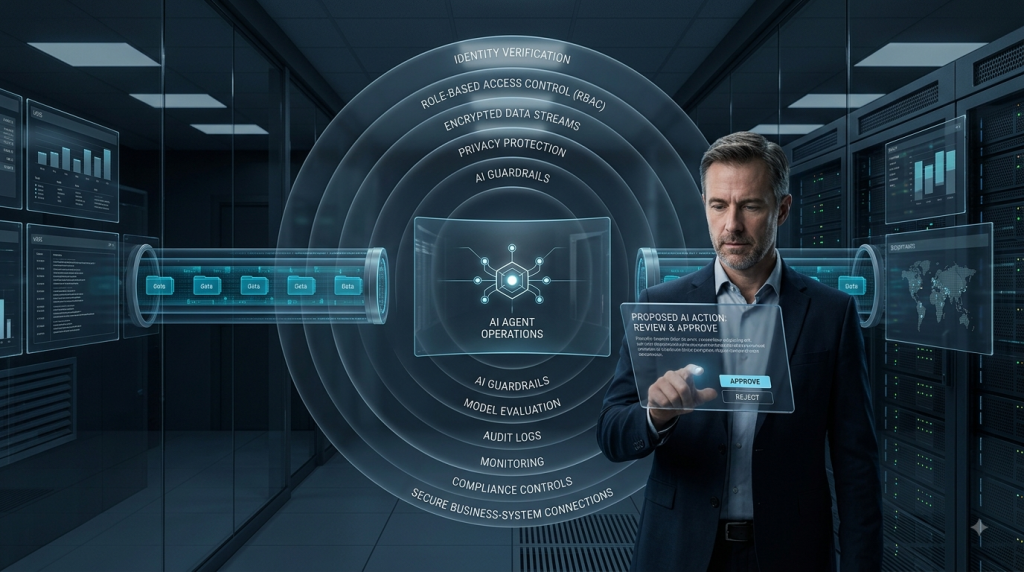
- AI agents increase the importance of permissions, approval workflows, monitoring, and controlled autonomy.
- Total cost of ownership should include infrastructure, engineering, security, integration, and operational costs.
- A controlled proof of concept is usually more useful than choosing a platform based only on marketing claims or benchmark headlines.
Why Enterprise AI Platform Selection Matters in 2026
The enterprise AI market has moved beyond simple chatbot experiments. Organizations are now evaluating AI for internal knowledge search, software development, customer service, analytics, document processing, workflow automation, decision support, and increasingly sophisticated AI agents.
The challenge is therefore no longer simply finding a powerful AI model. The harder question is determining which platform can connect that intelligence to the organization’s data, applications, employees, workflows, security controls, and governance processes.
Microsoft, Google Cloud, Amazon Web Services, IBM, Oracle, Salesforce, Databricks, and OpenAI all have meaningful enterprise AI offerings. However, they do not solve exactly the same problem.
Some platforms are deeply integrated with cloud infrastructure. Others specialize in CRM, enterprise data, AI governance, workforce productivity, or application development.
This guide compares the leading enterprise AI platforms for 2026 and explains where each one can make the most sense — as well as where an organization may want to think twice before committing.
What Is an Enterprise AI Platform?

An enterprise AI platform is a technology environment that helps organizations develop, deploy, operate, secure, monitor, and govern artificial intelligence applications at business scale.
That description sounds simple, but production enterprise AI requires considerably more than text generation.
A reasonably complete enterprise AI environment may include:
- Foundation and generative AI model access
- Machine learning development
- Retrieval-augmented generation (RAG)
- Vector search
- AI agents and orchestration
- APIs and SDKs
- Enterprise data integration
- Identity and access management
- Security controls
- AI evaluation
- Monitoring and observability
- Governance and audit capabilities
- Workflow automation
- Human approval processes
- Cost and usage management
The meaningful distinction between a consumer AI tool and an enterprise AI platform is often operational control.
Connecting an LLM to a test application can take only a few hours. Turning that experiment into a reliable production system requires permissions, data controls, testing, monitoring, security, governance, and an operating model.
How Enterprise AI Platforms Work
Although architectures differ between providers, most enterprise AI systems follow a broadly similar operational pattern.
1. Connect Enterprise Data
The platform connects to information such as:
- CRM records
- Databases
- Documents
- Knowledge bases
- Data warehouses
- ERP systems
- APIs
- Internal applications
Data quality and integration depth can have a major impact on the usefulness of an enterprise AI application.
2. Select and Configure AI Models
Enterprises may be able to select proprietary, open-weight, or third-party models depending on the platform and applicable licensing.
Important evaluation factors include:
- Accuracy
- Reasoning capability
- Context length
- Latency
- Cost
- Language support
- Privacy requirements
- Deployment flexibility
3. Ground Models With Business Context
Retrieval-augmented generation, commonly called RAG, allows an AI application to retrieve relevant information from approved business sources before generating an answer.
Consider an employee asking:
What does our current employee travel policy say?
A well-designed system should retrieve the organization’s current, approved policy rather than rely solely on a model’s general knowledge.
4. Add Tools and Controlled Actions
This is where AI agents differ from basic chatbots.
An agent can potentially retrieve information, reason over it, call authorized tools, and perform a permitted action.
A customer-support workflow might look like:
Customer request → Identity check → CRM lookup → Account verification → Proposed action → Human approval → Business-system update
5. Apply Security and Governance
Production AI requires controls defining:
- Who can access the system
- What data the system can access
- Which actions an agent can perform
- Which models employees can use
- How outputs are evaluated
- How sensitive information is handled
- How activity is monitored and audited
Best Enterprise AI Platforms for 2026

1. Microsoft Foundry — Best for Microsoft-Centric Enterprises
Microsoft Foundry is Microsoft’s unified Azure platform for enterprise AI operations, model development, and AI application development. Microsoft describes Foundry as bringing agents, models, tools, monitoring, evaluations, role-based access control, networking, and policy capabilities together within an Azure environment.
This makes it particularly relevant for organizations already operating heavily across Azure and Microsoft enterprise services.
Why It Fits Microsoft Environments
Companies already using Microsoft 365, Microsoft Entra ID, Azure infrastructure, and related Microsoft services may be able to reduce integration complexity by building AI within an ecosystem they already understand.
Key Strengths
- Deep Azure ecosystem integration
- Enterprise identity and access controls
- Centralized AI asset management
- Agent development and orchestration
- Monitoring and evaluation capabilities
- Enterprise governance capabilities
- Multiple development SDK options
Realistic Limitations
- Azure expertise is valuable for complex deployments
- Multi-service architectures can be difficult to estimate financially
- The ecosystem can be complex for small teams
- Organizations outside the Microsoft ecosystem may gain less integration value
Who Should Think Twice?
Companies primarily operating on another cloud may want to compare the migration and integration overhead before choosing Foundry simply because of its feature set.
Best Fit
A large organization already using Azure and Microsoft 365 that wants to move from isolated AI experiments toward governed production AI.
2. Google Gemini Enterprise Agent Platform — Best for AI and Agent Engineering
Google Cloud’s Gemini Enterprise Agent Platform is positioned as a comprehensive environment for building, scaling, governing, and optimizing enterprise AI agents and applications.
Google positions the platform around model choice, agent development, evaluation, customization, deployment, and enterprise data grounding. Its Model Garden provides access to Google and third-party models.
Why Engineering Teams May Prefer It
Google has longstanding strengths in machine learning research, data infrastructure, multimodal AI, cloud-native development, and Kubernetes. Those capabilities can be valuable for teams building sophisticated AI applications rather than simply deploying an employee chatbot.
Key Strengths
- Broad model selection
- Strong multimodal AI capabilities
- Agent development tooling
- AI evaluation capabilities
- Data and analytics integration
- Cloud-native architecture
Realistic Limitations
- Can require substantial cloud engineering expertise
- Architecture and pricing can become complex
- Teams unfamiliar with Google Cloud may face a learning curve
Who Should Think Twice?
Organizations looking mainly for a simple low-code deployment or companies already deeply invested in another cloud should carefully compare switching costs and integration requirements.
Best Fit
Companies with strong AI engineering or data science teams that want to build sophisticated AI agents and applications.
3. Amazon Bedrock — Best for AWS-Native AI Development
Amazon Bedrock provides managed access to foundation models through AWS and supports enterprise generative AI applications, retrieval workflows, agents, and related services.
One of Bedrock’s major advantages is model choice. Organizations can work with multiple model families rather than building their architecture around only one provider.
Important Capabilities
- Foundation model access
- Knowledge Bases
- RAG workflows
- Agent capabilities
- Guardrails
- Model customization options
- AWS service integration
- Enterprise security controls
Amazon Bedrock Knowledge Bases can retrieve information from connected data sources to improve responses using RAG. AWS also provides configurable guardrails that can evaluate inputs and model responses.
Important 2026 update: AWS documentation now distinguishes newer Bedrock agent architecture from the older Bedrock Agents Classic experience. Organizations evaluating a new deployment should verify the current recommended agent architecture rather than relying on older tutorials.
Key Strengths
- Strong AWS ecosystem integration
- Multiple foundation model options
- Managed retrieval capabilities
- Configurable guardrails
- Flexible cloud architecture
Realistic Limitations
- AWS architecture can be technically complex
- Costs can accumulate across multiple services
- Cloud engineering expertise is valuable
Best Fit
Enterprises already operating primarily on AWS that want to introduce generative AI, RAG, and agent capabilities within their existing cloud architecture.
4. IBM watsonx — Best for Governed and Hybrid Enterprise AI
IBM watsonx combines AI development, data capabilities, governance, and orchestration through components including watsonx.ai, watsonx.data, watsonx.governance, and watsonx Orchestrate.
Its strongest differentiation is the emphasis on governance, risk management, monitoring, policies, and enterprise AI lifecycle control.
Key Strengths
- Strong AI governance focus
- Hybrid and multi-cloud orientation
- AI lifecycle management
- Enterprise data capabilities
- Model flexibility
Realistic Limitations
- Enterprise implementation can be complex
- Specialist expertise may be required
- Smaller organizations may not require the full platform
- Licensing and architecture decisions require careful planning
Who Should Think Twice?
Small organizations with straightforward AI use cases may find a full governance-oriented enterprise platform more extensive than necessary.
Best Fit
Regulated and governance-sensitive organizations where AI risk management, auditability, hybrid infrastructure, and lifecycle control are important architectural requirements.
5. Oracle OCI Enterprise AI — Best for Oracle-Centric Organizations
Oracle announced the general availability of OCI Enterprise AI in March 2026 as an end-to-end offering for building, managing, and deploying production AI workloads.
Oracle’s approach combines models and inference, agents and tools, governance and security, and integration with Oracle’s enterprise infrastructure and data environment.
The Core Value Proposition
The strongest reason to evaluate OCI Enterprise AI is proximity to Oracle-based enterprise data and applications.
Organizations with significant Oracle investments across areas such as ERP, finance, supply chain, human resources, and databases may benefit from building AI capabilities close to those existing systems.
Key Strengths
- Deep Oracle ecosystem integration
- Enterprise database integration
- AI agent capabilities
- Governance and security capabilities
- Production-oriented infrastructure
- Model flexibility
Realistic Limitations
- Less compelling for organizations with little Oracle infrastructure
- OCI expertise may be required
- Enterprise deployments can be complex
Best Fit
Large organizations whose operational data and enterprise applications already depend heavily on Oracle technology.
6. Salesforce Agentforce — Best for CRM and Customer Operations
Salesforce Agentforce occupies a different position from general-purpose cloud AI infrastructure platforms. Its primary strength is connecting AI to CRM data, customer service, sales, marketing, and business workflows.
Practical Example
Imagine a customer contacts a company about a delayed order.
- Identify the customer
- Retrieve the order record
- Check shipping information
- Explain the current status
- Create or update a support case
- Escalate to a human when required
The value comes from connecting AI with business context and authorized actions rather than simply generating a conversational response.
Key Strengths
- Deep CRM integration
- Customer-service automation
- Sales workflow support
- Business data context
- Agent orchestration
Realistic Limitations
- Not a general-purpose cloud infrastructure replacement
- Strongest value depends on Salesforce adoption
- Licensing can become complex at enterprise scale
Best Fit
Companies whose most important AI opportunities involve customer service, sales, CRM, marketing, and related customer operations.
7. Databricks — Best for Data-First AI Organizations
Databricks occupies a distinctive position because its enterprise AI strategy is closely connected to data engineering, analytics, model serving, and governance.
For organizations that already operate a substantial Databricks data environment, the platform can provide a strong foundation for connecting enterprise data with AI applications.
Key Strengths
- Strong data engineering foundation
- AI and analytics integration
- Model and AI governance capabilities
- Multi-model support
- Strong developer ecosystem
2026 status note: Databricks documentation currently describes Unity AI Gateway as a Beta capability. Organizations should therefore verify its current availability, feature coverage, and production suitability before using it as the basis for a critical architecture decision.
Realistic Limitations
- Strong data engineering skills are valuable
- The platform may be excessive for simple chatbot deployments
- Organizations without mature data teams may face a learning curve
Best Fit
Data-intensive organizations that view enterprise AI as an extension of their data, analytics, and intelligence strategy.
8. OpenAI — Best for Workforce AI Productivity and Application Development
OpenAI occupies a somewhat different position from cloud infrastructure providers. Its enterprise offering includes workplace AI capabilities, while its API platform allows developers to build custom applications around OpenAI models.
OpenAI states that, by default, it does not train its models on inputs and outputs from business products such as ChatGPT Business, ChatGPT Enterprise, and the API.
Key Strengths
- Strong end-user AI experience
- General-purpose AI capabilities
- Developer APIs
- Enterprise administration
- Growing agent capabilities
- Broad knowledge-worker productivity use cases
Realistic Limitations
- Not a complete replacement for cloud infrastructure
- Organizations may still need separate data and networking architecture
- Regulated workloads require careful review of specific controls and contractual terms
- Enterprise architecture may require integration with existing identity and governance systems
Who Should Think Twice?
Organizations looking for one provider to supply both their complete cloud infrastructure and every layer of their AI architecture may want to compare OpenAI with their existing cloud provider’s AI platform.
Best Fit
Organizations seeking broad AI productivity across knowledge workers, developers, analysts, researchers, and teams building custom AI applications.
Enterprise AI Platform Comparison
| Platform | Best For | Model Flexibility | Agent Capability | Governance | Data Strength |
|---|---|---|---|---|---|
| Microsoft Foundry | Microsoft-centric enterprises | Strong | Strong | Strong | Strong |
| Google Gemini Enterprise Agent Platform | AI engineering teams | Excellent | Strong | Strong | Strong |
| Amazon Bedrock | AWS-native enterprises | Excellent | Strong | Strong | Strong |
| IBM watsonx | Regulated and hybrid enterprises | Strong | Strong | Excellent | Strong |
| Oracle OCI Enterprise AI | Oracle-centric organizations | Strong | Strong | Strong | Strong |
| Salesforce Agentforce | CRM and customer operations | Moderate | Excellent | Strong | Strong |
| Databricks | Data-first organizations | Strong | Strong | Strong | Excellent |
| OpenAI | Workforce productivity and applications | Moderate | Growing | Strong | Moderate |
Editorial assessment: These labels are qualitative editorial assessments, not independent laboratory benchmark scores. Actual capabilities, pricing, availability, performance, and enterprise terms can vary by product tier, workload, region, architecture, and contract.
Which Enterprise AI Platform Should You Choose?
Start with your existing technology environment. This is not simply a matter of convenience. Integration with existing identity systems, databases, applications, cloud services, and developer workflows can significantly affect implementation cost and operational complexity.
Choose Microsoft Foundry If:
- Your organization relies heavily on Microsoft 365 and Azure.
- You need centralized AI governance.
- Your developers already work extensively with Azure.
Choose Google Gemini Enterprise Agent Platform If:
- You have an AI engineering or data science team.
- You need broad model choice.
- You are developing advanced AI agents or multimodal applications.
Choose Amazon Bedrock If:
- AWS is your primary cloud.
- You want access to multiple model families.
- You need managed RAG and agent capabilities integrated with AWS.
Choose IBM watsonx If:
- AI governance is a major requirement.
- You operate in a regulated environment.
- Hybrid or multi-cloud architecture matters.
Choose Oracle OCI Enterprise AI If:
- Your organization depends heavily on Oracle databases or applications.
- Your AI workloads need close access to Oracle enterprise data.
- OCI fits your existing infrastructure strategy.
Choose Salesforce Agentforce If:
- Customer operations are a major AI opportunity.
- Sales automation is important.
- Salesforce is already your CRM environment.
Choose Databricks If:
- Your organization is highly data-intensive.
- AI depends heavily on governed enterprise data.
- You have mature data engineering capabilities.
Choose OpenAI If:
- You want broad workforce AI productivity.
- Your employees need advanced AI assistance.
- Your developers want to build custom AI applications.
These are analytical starting points rather than guarantees. The strongest next step is usually a proof of concept using a real business workload.
What to Evaluate Before Buying an Enterprise AI Platform
1. Model Flexibility
Ask whether your organization can use multiple models, switch providers, route different workloads to different models, and incorporate open models where appropriate.
2. Data Integration
Verify support for the databases, data warehouses, CRM systems, ERP platforms, document repositories, APIs, and knowledge systems your organization actually uses.
A highly capable model with poor access to business context may deliver less useful results than a slightly less capable model connected to accurate enterprise data.
3. Security
Evaluate:
- Encryption
- Identity management
- SSO
- Role-based access control
- Private networking
- Data residency
- Audit logging
- Secrets management
- Permission boundaries
Never assume that the word “enterprise” automatically means a platform satisfies your exact compliance obligations. Security, legal, privacy, and compliance teams should verify the specific controls that apply to your organization.
4. AI Governance
Governance should span the AI lifecycle rather than exist only as a compliance document.
- Inventory AI systems
- Evaluate models and applications
- Define policies
- Monitor usage
- Track risks
- Maintain audit trails
- Control agent permissions
- Manage human approvals
- Monitor production behavior
5. AI Evaluation
Before production deployment, create an evaluation dataset containing:
- Correct answers
- Incorrect or misleading examples
- Ambiguous requests
- Sensitive requests
- Out-of-scope questions
- Prompt injection attempts
- Hallucination-prone scenarios
Measure accuracy, relevance, groundedness, latency, cost, safety, and task completion. A benchmark headline alone does not tell you whether a platform will perform well for your actual workload.
6. Observability
Production AI requires ongoing monitoring.
- Requests and responses
- Token usage
- Latency
- Error rates
- Model performance
- Retrieval quality
- Agent actions
- Human escalations
- Cost
7. Total Cost of Ownership
Model inference is only one part of the financial picture.
A realistic enterprise AI cost model may include:
Inference + storage + vector databases + networking + data processing + monitoring + security + licensing + integration engineering + developer time + support
A platform with low model pricing can still become expensive if your organization must build and maintain substantial infrastructure around it.
Enterprise AI Platform Buying Checklist
Before signing an enterprise agreement, evaluate the following:
- Existing cloud and application ecosystem alignment
- Data location and residency requirements
- Model flexibility
- Multi-model strategy
- AI agent capabilities
- Agent permission controls
- Security controls
- Identity, SSO, and role-based access
- Governance and compliance workflows
- API and SDK quality
- Integration complexity
- Developer skills and team readiness
- Monitoring and observability
- Pricing predictability
- Support and SLA options
- Vendor lock-in risk
- Migration difficulty
- Total cost at projected scale
A Practical Enterprise AI Deployment Example
Consider a 500-person organization with a large internal knowledge base. The company wants to build an AI assistant that answers employee questions.
A Poorly Designed Approach
The company connects a generic chatbot to internal documents and asks employees to trust its answers.
Potential problems include:
- Outdated information
- Hallucinations
- Unauthorized information exposure
- No source attribution
- No audit trail
A Better Architecture
Employee → Identity verification → AI application → Retrieval system → Approved company documents → AI model → Safety checks → Answer with sources
For actions requiring business authority:
Employee → AI agent → Retrieve relevant data → Propose action → Human approval → Business system
This design separates AI reasoning from transactional authority. It also creates clearer boundaries for permissions, monitoring, and accountability.
Enterprise AI Adoption Strategy
Step 1: Identify One Valuable Problem
Do not begin by purchasing the largest platform available. Begin with one measurable business problem.
- Reduce customer-support response time
- Improve internal knowledge search
- Accelerate software development
- Automate document classification
- Improve research workflows
- Automate a repetitive back-office process
Step 2: Define Success Metrics
Establish measurable outcomes before deployment.
Examples include reduced handling time, faster first responses, lower manual processing requirements, improved search success, or measurable developer productivity improvements.
Step 3: Classify Your Data
Determine whether the AI system will process:
- Public information
- Internal information
- Confidential information
- Personally identifiable information
- Financial information
- Regulated information
Step 4: Select the Platform
Use your existing technology environment as the first filter, then compare two or three realistic candidates against the same workload.
Step 5: Build a Controlled Pilot
Start with a limited group of users and test:
- Accuracy
- Security
- User experience
- Latency
- Cost
- Integration
- Governance
Step 6: Red-Team the System
Actively try to make the system fail before production users do.
- Prompt injection
- Data leakage
- Unauthorized access
- Hallucinations
- Privilege escalation
- Sensitive-data exposure
- Out-of-scope requests
Step 7: Deploy Progressively
A practical progression is:
Read → Recommend → Human approval → Limited automation → Controlled autonomy
An organization should not give an autonomous agent unrestricted access to critical production systems before its reliability, permissions, and failure modes have been thoroughly tested.
Advantages of Enterprise AI Platforms
Faster Development
Managed services can reduce the amount of infrastructure that development teams need to build and maintain themselves.
Better Business Context
RAG and enterprise data integration can make AI applications more relevant to current organizational information.
Centralized Governance
Organizations can establish policies around models, applications, users, and agents.
Scalability
Enterprise platforms can support workloads ranging from controlled pilots to larger production systems.
Workflow Automation
Appropriately controlled AI agents can handle multi-step workflows while preserving human approval where business risk requires it.
Workforce Productivity
AI can assist developers, analysts, researchers, marketers, customer service teams, and other knowledge workers when the deployment is designed around useful tasks and appropriate controls.
Risks and Limitations of Enterprise AI
Hallucinations
AI systems can generate incorrect information with convincing language. Retrieval, evaluation, and human review can reduce this risk but cannot eliminate it completely.
Data Leakage
Poorly configured permissions, integrations, or retrieval systems can expose sensitive information.
Vendor Lock-In
Deep integration with one provider can make future migration more difficult and expensive.
Cost Growth
AI workloads can become significantly more expensive as usage increases, especially when multiple supporting services are involved.
Integration Complexity
Connecting AI to legacy enterprise systems can require substantial engineering effort and ongoing maintenance.
Governance Complexity
Organizations need clear ownership, policies, monitoring, and accountability across AI deployments.
Over-Automation
An AI agent with excessive permissions can turn a relatively small model error into a larger operational incident.
Enterprise AI Trends to Watch in 2026
1. AI Agents Are Becoming More Operational
Enterprise AI is increasingly moving from systems that simply answer questions toward systems that can execute multi-step workflows.
This increases the importance of:
- Agent orchestration
- Tool access
- Retrieval
- Memory
- Permissions
- Monitoring
- Human approval
2. Multi-Model Strategies Are Becoming More Practical
Organizations increasingly have access to multiple model families. Different workloads may therefore use different models.
For example:
- A reasoning-focused model for complex analysis
- A smaller model for high-volume classification
- A specialized model for coding
- A locally deployed model for selected sensitive workloads
3. AI Governance Is Becoming Architecture
Guardrails, evaluation, auditability, cost controls, model inventories, and agent permissions are increasingly becoming technical platform capabilities rather than purely administrative processes.
4. Enterprise Data Is Becoming More Important
The model is only one component of an AI system. Organizations increasingly compete on how effectively they connect AI to proprietary data, business processes, customer context, and internal knowledge.
In many enterprise applications, the strongest combination is:
Model + Data + Workflow + Governance
5. Interoperability Is Becoming a Buying Criterion
Enterprises increasingly need AI agents and applications to work across multiple business systems. APIs, connectors, identity standards, and interoperability therefore deserve consideration during platform selection.
Frequently Asked Questions
What is the best enterprise AI platform in 2026?
There is no single best platform for every organization. Microsoft Foundry can be a strong starting point for Microsoft-centric enterprises, Amazon Bedrock for AWS environments, Google Gemini Enterprise Agent Platform for AI engineering, IBM watsonx for governance-heavy deployments, Oracle OCI Enterprise AI for Oracle-centric organizations, Salesforce Agentforce for CRM operations, Databricks for data-intensive environments, and OpenAI for workforce productivity and application development. What is the best AI platform for large enterprises?
Large enterprises should evaluate security, governance, data integration, model flexibility, agent capabilities, deployment options, observability, developer skills, and total cost of ownership. Existing infrastructure alignment can be more important than a model benchmark advantage. Is Microsoft Foundry better than Amazon Bedrock?
Neither is universally better. Microsoft Foundry can be particularly attractive to organizations invested in Azure and Microsoft 365, while Amazon Bedrock is a natural option for AWS-native organizations seeking managed access to multiple model families and AWS integrations. Which enterprise AI platform is best for AI agents?
Several platforms provide substantial agent capabilities. The best option depends on the systems an agent must access, the required level of autonomy, the available tools, security architecture, and governance requirements. Which enterprise AI platform is best for regulated industries?
Regulated organizations should prioritize governance, security controls, auditability, data residency, deployment flexibility, and contractual requirements. IBM watsonx is particularly focused on governance, while major cloud providers also provide extensive security and compliance capabilities. Exact requirements should be verified with the provider and the organization’s legal and compliance teams. Are enterprise AI platforms expensive?
Costs vary significantly. Expenses may include model inference, storage, networking, databases, monitoring, security, licenses, support, and engineering time. A small pilot can have a manageable cost, while a large production deployment may require substantial infrastructure and operational investment. Can enterprises use multiple AI platforms?
Yes. A multi-platform strategy can make sense when different workloads have different requirements. The trade-off is additional governance, integration, security, and operational complexity. What should companies look for in an enterprise AI platform?
Important factors include model flexibility, security, data integration, governance, AI evaluation, observability, agent capabilities, APIs, deployment flexibility, scalability, support, ecosystem fit, and total cost of ownership. What is the difference between an enterprise AI platform and an AI chatbot?
A chatbot primarily provides a conversational interface. An enterprise AI platform is a broader technology environment that can provide models, data integration, retrieval, agents, APIs, security, governance, evaluation, monitoring, and deployment capabilities. Will AI agents replace enterprise software?
AI agents are more likely to change how people interact with enterprise software than immediately replace the underlying systems. CRM, ERP, databases, identity systems, and other business applications remain important sources of data and transactional authority.
Related AI Guides
- What Is Generative AI and How Does It Work?
- Best AI Tools for Business in 2026
- AI Agents vs Generative AI
- How to Use RAG for Enterprise AI
- AI Governance and Security Guide
Conclusion: Which Enterprise AI Platform Is Right for You?
The most useful question is not simply: “Which enterprise AI platform is the best?”
A better question is: “Which platform fits our data, people, security requirements, technology architecture, workflows, and business objectives?”
Microsoft Foundry is a strong candidate for Microsoft-centric enterprises. Google Gemini Enterprise Agent Platform is compelling for organizations building advanced AI applications and agents. Amazon Bedrock fits naturally into AWS environments. IBM watsonx is particularly relevant where governance and hybrid architecture are important. Oracle OCI Enterprise AI is especially relevant to Oracle-heavy organizations. Salesforce Agentforce is strongly aligned with CRM and customer operations. Databricks brings AI close to enterprise data, while OpenAI provides powerful options for workforce productivity and application development.
The practical approach is straightforward:
- Identify one meaningful business problem.
- Define measurable success criteria.
- Select two or three realistic platform candidates.
- Test them using the same workload.
- Evaluate security and governance.
- Measure quality, latency, and cost.
- Run a controlled pilot.
- Expand only after demonstrating reliability.
The organizations that successfully deploy enterprise AI are not necessarily those with the biggest budgets or newest models. They are often the ones that match the right technology to a well-defined problem, establish appropriate governance, and expand only after testing the system under realistic conditions.
In 2026, enterprise AI success is becoming less about asking:
Which AI model is the smartest?
And more about asking:
Which platform can connect the right intelligence to the right data, workflow, people, and controls?
That is the question organizations should answer before committing to an enterprise AI platform.
How We Compared These Enterprise AI Platforms
This comparison evaluates enterprise AI platforms using several practical dimensions:
- Enterprise ecosystem integration
- Model flexibility
- AI agent capabilities
- Enterprise data integration
- Security and governance
- Developer experience
- Observability
- Deployment flexibility
- Operational complexity
- Total cost of ownership considerations
We do not treat vendor marketing claims as independent laboratory benchmarks. The comparison is intended to help technology decision-makers structure their evaluation rather than replace a formal procurement, security, legal, or technical assessment.
Platform coverage reflects publicly available documentation and announced capabilities reviewed for this article as of August 13, 2026.
Official Documentation and Sources
Because enterprise AI platforms change rapidly, readers should use official documentation when checking current features, pricing, regional availability, security controls, and contractual terms.
- Microsoft Foundry — Microsoft Learn
- Google Gemini Enterprise Agent Platform — Google Cloud
- Amazon Bedrock — AWS Documentation
- IBM watsonx — IBM
- Oracle OCI Enterprise AI — Oracle
- Salesforce Agentforce — Salesforce
- Databricks AI — Databricks Documentation
- OpenAI Business Data — OpenAI
Editorial Disclosure
This article is intended for educational and informational purposes. It does not constitute financial, legal, security, compliance, procurement, or professional technology advice.
Product capabilities, pricing, availability, data-handling policies, security certifications, regional support, and contractual terms can change. Organizations should verify important details directly with the relevant provider and their internal security, legal, privacy, procurement, and engineering teams before purchasing or deploying an enterprise AI platform.
Affiliate disclosure: If this website later includes affiliate links within this article, any applicable affiliate relationship will be clearly disclosed. Affiliate relationships do not determine the editorial methodology or qualitative assessments presented above.
Last reviewed: August 13, 2026
This article reflects publicly available information available at the time of review. Enterprise AI platforms evolve quickly, so readers should verify current product capabilities, pricing, regional availability, security documentation, and contractual terms directly with providers.
AI Agents in 2026: The Powerful Revolution Transforming Work, Business & Productivity